


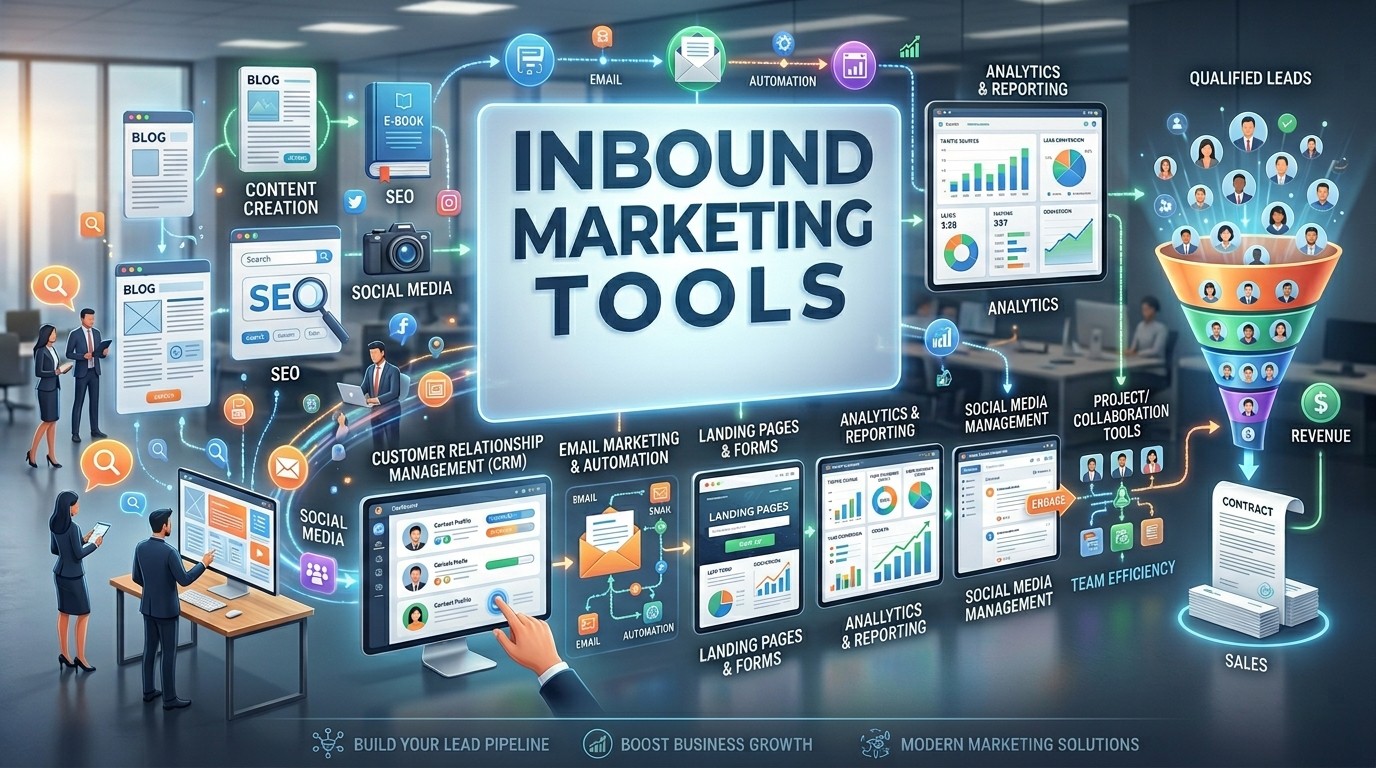
Inbound Marketing Tools help businesses attract the right audience, capture interest at the moment it appears, and turn curiosity into qualified leads without forcing attention through interruption.
Most teams do not struggle because they lack traffic. They struggle because traffic arrives without structure, follow-up, or a clear path to conversion. These tools solve that gap by giving marketers a system for attracting, nurturing, measuring, and converting visitors in a way that feels helpful instead of pushy. When the process is done well, the audience experiences value first, and the brand earns trust second.
The best lead generation strategy is rarely a single tactic. It is a connected system of content, forms, tracking, automation, and sales alignment. These tools matter because they connect those moving parts into one practical workflow. They help marketers see where leads come from, what content they consume, when they are ready to engage, and which actions are most likely to move them forward.
Why Inbound Works Better for Modern Lead Generation
People have become selective about what they pay attention to. That is why interruption-heavy outreach often feels expensive and inefficient. Inbound Marketing Tools fit the modern buyer because they support discovery on the buyer’s terms. A person can read a guide, download a checklist, compare solutions, or subscribe for more information without feeling pressured.
That psychological difference matters. When someone chooses to engage, they are usually more open to the next step. Inbound Marketing Tools help preserve that momentum by making each stage clearer and easier to complete. Instead of forcing a hard sell, the system reduces friction and keeps the experience aligned with the buyer’s intent.
Core Categories of Inbound Marketing Tools
| Category | Primary Purpose | Lead Gen Benefit |
|---|---|---|
| Content tools | Plan and publish | Attract search and social traffic |
| Capture tools | Forms and landing pages | Convert visitors into leads |
| Automation tools | Nurture and score | Move leads through the funnel |
| Analytics tools | Track behavior | Improve conversion decisions |
| Sales alignment tools | Share context with sales | Improve handoff quality |
The strongest teams do not choose tools randomly. They use Inbound Marketing Tools as a connected system that supports each stage of the customer journey. That is what turns marketing activity into measurable lead generation.
Content Planning and SEO Support

Content is the first layer of most inbound systems. Inbound Marketing Tools help marketers identify topics, organize publishing calendars, and structure pages so they are easier for search engines and people to understand. A useful article, guide, or resource can continue generating leads long after it is published.
Good content works because it answers a question at the exact moment the user needs help. Inbound Marketing Tools make it easier to find those questions and build content around them. When content maps to intent, traffic becomes more likely to convert into subscribers or sales conversations.
Search visibility also improves when the site is organized around clear themes. Inbound Marketing Tools support this by helping teams manage keywords, internal links, and topic clusters. That creates a stronger path from discovery to lead capture because users can move from one relevant resource to the next without confusion.
Landing Pages and Forms
A landing page should do one job well: persuade the visitor to take one next step. Inbound Marketing Tools help teams build pages that are clear, focused, and easy to act on. The best pages do not overwhelm users with unnecessary options. They reduce choice and make the offer feel valuable.
Forms are where curiosity turns into contact. Inbound Marketing Tools make form design easier by allowing marketers to test field length, placement, and calls to action. A shorter form often converts better, but the right balance depends on how much information is needed for qualification.
Trust plays a major role here. If a form feels too demanding, the visitor may leave. Inbound Marketing Tools improve form performance by letting marketers match the request to the value offered. When the exchange feels fair, more users are willing to share their information.
Lead Magnets and Offer Design
People exchange contact details when the offer feels genuinely useful. Inbound Marketing Tools support lead magnets such as checklists, white papers, templates, calculators, and webinars. The stronger the perceived value, the easier it becomes to convert anonymous visitors into known leads.
The offer should solve a small but meaningful problem. Inbound Marketing Tools help marketers test which topics, formats, and headlines drive the highest response. A useful lead magnet does not need to be large. It needs to feel relevant, specific, and practical.
Offer design should also match the stage of awareness. Someone new to the topic may respond to a beginner guide, while a more advanced prospect may prefer a comparison sheet or buying checklist. Inbound Marketing Tools make segmentation easier so each visitor sees the most appropriate next step.
Email Nurture and Automation
Not every lead is ready to buy immediately. That is where nurturing becomes important. Inbound Marketing Tools allow teams to build automated email sequences that educate, build trust, and keep the brand visible until the prospect is ready to act.
Automation works best when it feels timely and useful. Inbound Marketing Tools can trigger messages based on downloads, page visits, clicks, or form submissions. That helps marketers respond to behavior rather than sending the same message to everyone. When the message feels relevant, engagement tends to improve.
Nurture also protects revenue from leakage. A lead who is not ready today may still convert later if the follow-up is useful. Inbound Marketing Tools keep that relationship alive without requiring manual effort for every interaction. That makes the system more scalable and more consistent.
Lead Scoring and Sales Readiness
One of the hardest parts of lead generation is knowing who is ready for sales. Inbound Marketing Tools support scoring systems that assign value based on behavior and fit. This helps teams focus on leads that are more likely to progress, rather than treating every contact as equally urgent.
Scoring works because it combines activity and intent. A person who opens emails, visits pricing pages, and returns multiple times may deserve more attention than someone who only downloaded a single resource. Inbound Marketing Tools make that prioritization more practical and easier to manage.
This is where sales and marketing alignment becomes crucial. If marketing passes every lead too early, sales wastes time. If marketing waits too long, opportunities slip away. Inbound Marketing Tools help both teams use the same definition of readiness so the handoff becomes cleaner.
Alignment Between Teams
Many organizations lose leads because the handoff between marketing and sales is weak. Inbound Marketing Tools reduce that problem by creating shared visibility into the customer journey. When both teams can see the same history, the conversation becomes more informed and the buyer experience becomes smoother.
Hubspot Sales Marketing Alignment Tools are a strong example of how connected systems can reduce friction between departments. When data, tasks, and lifecycle stages are shared clearly, teams spend less time debating ownership and more time helping the prospect. That shift often improves response speed and conversion quality.
Alignment is not only a software problem. It is also a process problem. Inbound Marketing Tools work best when both teams agree on definitions, follow-up timing, and success metrics. Once those rules are clear, the pipeline becomes easier to forecast and easier to grow.
Analytics and Attribution
Good lead generation depends on knowing what actually works. Inbound Marketing Tools help teams measure traffic sources, content engagement, conversion rates, and lead quality. Without that measurement layer, it becomes difficult to know which channels deserve more investment.
Attribution is especially important when multiple touchpoints influence a conversion. A user may first find a blog post, later return through email, and then fill out a form after seeing a remarketing message. Inbound Marketing Tools help connect those steps so the team can understand the full journey instead of only the final click.
For ecommerce brands, tracking is even more important because purchase paths can include content, retargeting, and product browsing. Ecommerce Channel ROAS Tracking helps teams understand which channels are producing actual return, while Ecommerce Server Side Tracking Analytics can improve measurement quality when browser limitations make client-side data incomplete.
Conversion Optimization
Conversion is not just about traffic volume. It is about making the next step feel safe, simple, and worth the effort. Inbound Marketing Tools help teams test page layout, copy, button placement, page speed, and call-to-action clarity. Small improvements often compound into meaningful lead gains over time.
User psychology plays a large role here. Visitors decide quickly whether a page feels credible. Inbound Marketing Tools help marketers present proof, reduce anxiety, and keep the path to conversion visible. The easier the page feels to understand, the more likely people are to act.
The best teams do not rely on guesswork. They test variations and study real behavior. Inbound Marketing Tools make that process more repeatable, which helps the organization improve from data instead of opinions.
Choosing the Right Stack

There is no single perfect stack for every company. The right combination depends on budget, team size, sales cycle, and content strategy. Inbound Marketing Tools should be chosen by use case, not by popularity. A small team may need only a few core functions, while a larger organization may need deeper automation and reporting.
Best B2B Marketing Tools usually emphasize lead capture, nurturing, CRM sync, and attribution because long sales cycles require more context. In a B2B environment, the buyer usually wants proof, not hype, so the stack must support education and trust-building.
The smart approach is to start with the biggest bottleneck. If the problem is traffic, focus on content and SEO. If the problem is conversion, improve landing pages and offers. If the problem is handoff, strengthen alignment. Inbound Marketing Tools become more valuable when they remove the specific blockage that is hurting performance most.
Practical Workflow for Lead Gen
A simple workflow can produce strong results when every stage is clear. First, attract the right visitor with useful content. Then offer a resource or action that feels relevant. Next, capture the lead and segment the contact based on behavior or intent. After that, nurture with useful follow-up until the lead becomes ready for sales.
Inbound Marketing Tools support each stage of that flow. The system works best when it feels connected, because disconnected tools create data gaps and make the buyer journey harder to understand. A clean workflow also makes internal collaboration easier, since everyone can see what happened and what should happen next.
This is why process matters as much as platform choice. The tools are only useful when they reinforce a clear strategy. Inbound Marketing Tools are most effective when they help the team keep promises, follow through consistently, and learn from every interaction.
Common Mistakes to Avoid
One common mistake is focusing on tool count instead of process quality. A large stack does not guarantee better results. Inbound Marketing Tools should be added only when they create real clarity, speed, or conversion improvement.
Another mistake is collecting leads without nurturing them. A database full of cold contacts does not create revenue by itself. Inbound Marketing Tools are meant to support relationships, not just lists.
A third mistake is ignoring data quality. If tracking is broken, decisions will be wrong. Inbound Marketing Tools should be configured carefully so attribution, segmentation, and reporting remain trustworthy. Clean data leads to better decisions, and better decisions lead to stronger lead generation.
Why Human Psychology Matters
People respond to progress, simplicity, and trust. That is why lead generation works best when it feels like a helpful next step rather than a forced request. Inbound Marketing Tools help create that feeling by making offers clear and follow-up timely.
The psychology of commitment is especially important. Once someone downloads something useful, they are more open to the next conversation. Inbound Marketing Tools use that momentum by matching follow-up to the behavior that created the lead in the first place.
Credibility also matters. Visitors are more likely to engage when the brand feels organized and knowledgeable. Inbound Marketing Tools support that image by helping content, offers, and follow-up appear consistent and professional.
How Marketing and Revenue Connect
Inbound is not just about generating contacts. It is about creating a predictable route from attention to opportunity. Inbound Marketing Tools help connect content, capture, nurture, and conversion into one revenue-oriented process. That is what makes the system valuable beyond simple traffic growth.
When teams can see which actions lead to sales conversations, they can invest more wisely. Inbound Marketing Tools make that possible by tying performance to real outcomes instead of vanity metrics. That gives leaders a better basis for planning budgets, staffing, and campaigns.
The long-term advantage is compounding. Each piece of content, each lead magnet, and each automation sequence can continue producing value after launch. Inbound Marketing Tools are powerful because they turn one-time effort into repeatable lead generation.
Conversion Assets and Offer Strategy
A funnel can only convert well when the offer feels worth the exchange. Strong marketers spend time refining the value proposition, the supporting proof, and the wording around the next step. People rarely hand over details just because a form exists. They do it when the offer reduces uncertainty and promises a useful outcome.
This is where editorial planning and campaign planning meet. A blog post can create initial interest, but the landing page and follow-up sequence must keep that interest alive. The strongest teams treat every asset as part of one journey instead of separate pieces.
That journey becomes even more effective when the offer feels specific to the problem at hand. A generic ebook usually performs worse than a narrowly focused checklist or template. Clear offers reduce hesitation because the visitor can quickly judge whether the value is real.
A good system also supports testing. Teams should be able to compare headline versions, button copy, and proof points without rebuilding the whole campaign. Fast testing improves learning, and learning improves performance. Over time, that discipline makes campaigns more efficient and more predictable.
Reporting, Forecasting, and Team Coordination
Once leads enter the system, the team needs a reliable way to understand what happens next. Reports should not just show volume. They should show lead quality, conversion paths, and the points where prospects fall away. That is how managers decide where to improve the process.
Reporting becomes more useful when the data tells a story. If a source creates traffic but weak lead quality, the issue may be the message, the audience, or the offer. If a channel creates fewer leads but stronger sales opportunities, the team may want to invest more there. Numbers only help when they support decisions.
Forecasting also improves when the data is clean. A team that understands historical conversion patterns can estimate pipeline more accurately and plan resources with less anxiety. Clear coordination between marketing and sales is essential because the handoff often determines whether a lead becomes revenue or disappears.
The more the organization works from shared metrics, the less it depends on guesswork. Good reporting creates confidence, and confidence improves action. That is one of the quiet strengths of a well-built inbound system.
Ecommerce Tracking and Revenue Visibility
For ecommerce brands, the measurement question is even more urgent because every channel can affect purchase behavior. A visitor may browse content, return through retargeting, and complete the order later from a different device. That is why Ecommerce Channel ROAS Tracking matters so much for budget decisions.
A team cannot improve what it cannot see. When attribution is weak, profitable channels may be cut too early, and weak channels may keep receiving budget because the data looks incomplete. Ecommerce Server Side Tracking Analytics helps reduce that blind spot by improving visibility when browser-side tracking is less dependable.
This level of clarity helps marketers move from assumptions to evidence. They can see which campaigns contribute to actual return, which messages support revenue, and which audience segments respond best. That makes the whole marketing engine more stable.
Even when the business is not ecommerce-first, the lesson still matters. Strong measurement builds stronger confidence. It also protects the marketing team from making expensive mistakes based on partial signals.
People, Process, and Long-Term Growth

Tools matter, but people and process decide whether the system succeeds. Teams need a repeatable cadence for publishing, review, handoff, and improvement. Without that rhythm, even the best software becomes underused. A healthy inbound operation should feel like a working habit, not a rescue project.
Leadership plays a major role here. When managers encourage shared ownership, the team is more likely to keep the system clean and consistent. That consistency matters because marketing performance often improves slowly, through many small gains that build on each other.
The same principle applies to reporting and feedback. If the team reviews performance regularly, it can catch issues earlier and adapt faster. Small adjustments are usually better than large disruptions, especially when campaigns are already working but could be working better.
Long-term growth usually comes from disciplined iteration. Each new insight should improve the next campaign, the next page, or the next sequence. That habit compounds over time and creates a business that is easier to scale.
Conclusion
A strong inbound system does more than collect names. It creates a respectful path from curiosity to trust to action. When the right content attracts the right person, the right offer captures attention, and the right follow-up keeps the relationship moving, lead generation becomes far more predictable. The most effective teams do not rely on one channel or one tactic. They use a connected process that combines planning, capture, nurturing, measurement, and team alignment. That is what makes the whole system durable. In the end, the best results come from making the buyer’s experience easier while making the marketing process smarter, cleaner, and more measurable.
Frequently Asked Questions (FAQ)
1. What makes this system so useful for lead generation?
They help turn attention into action by making content, offers, forms, and follow-up work together in a clear system.
2. Do small teams really need these tools?
Yes. Small teams often benefit the most because good automation and clean workflows save time and reduce missed opportunities.
3. How do I know which tool to start with?
Start with the biggest problem. If traffic is weak, begin with content. If conversion is weak, begin with landing pages and forms.
4. Why is sales alignment so important?
Because leads move faster when marketing and sales agree on readiness, timing, and follow-up. That reduces friction and lost opportunities.
5. Are analytics and attribution really necessary?
Yes. Without them, it is hard to know which channels, pages, and offers actually produce useful leads and revenue.
6. What is the role of lead magnets?
They give visitors a reason to share contact information by offering something valuable, specific, and easy to use.
7. How can I improve conversion without buying more traffic?
Improve the clarity of the offer, reduce friction on the page, and make the next step obvious and safe.
8. What is the biggest mistake teams make?
They often buy tools without a clear process. Software works best when it supports a strong strategy.
9. How should ecommerce teams think about tracking?
They should measure the full path to purchase, not just the final click, because the customer journey is usually longer than one session.
10. What is the long-term benefit of a good inbound system?
It compounds. Every useful page, sequence, and offer can continue creating value after it is launched.


Leave a Reply