


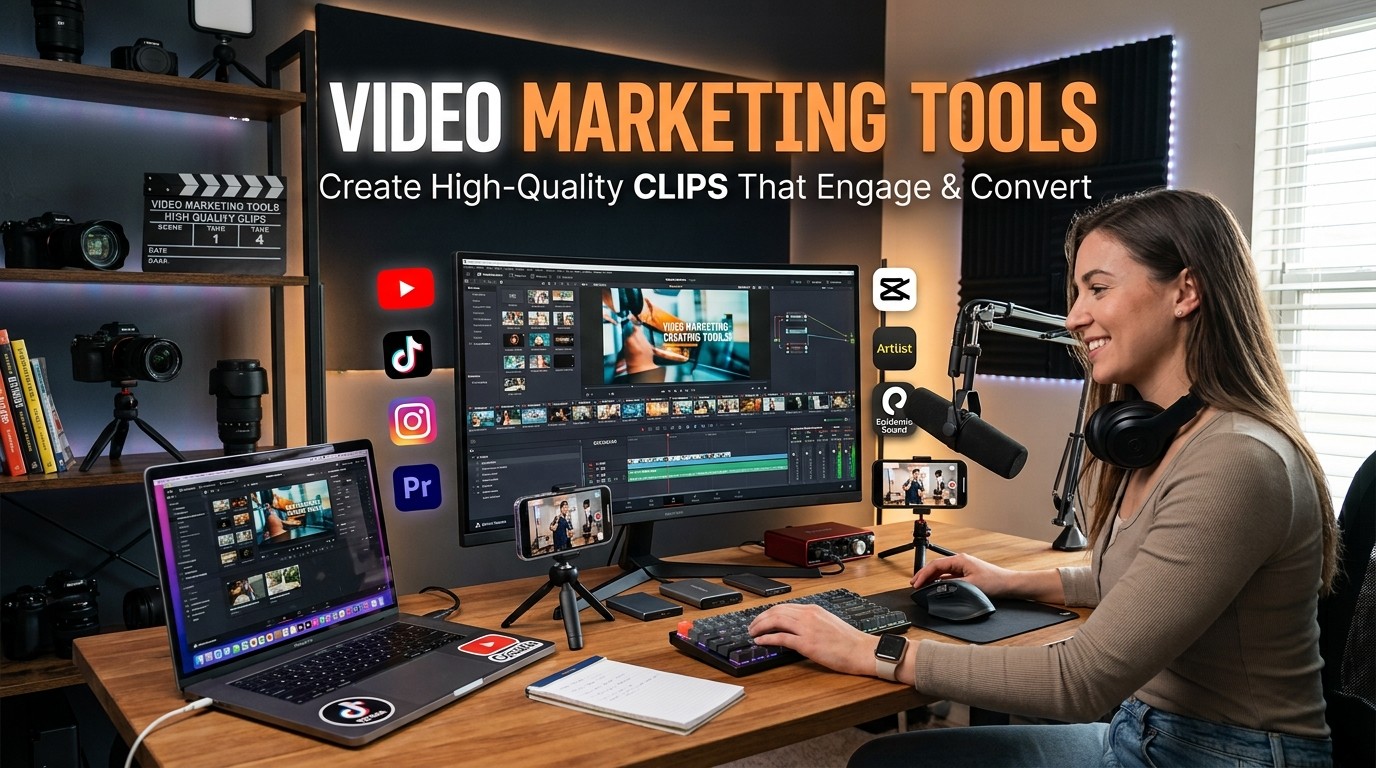
The right Video Marketing Tools help brands turn long footage into polished clips that attract attention, explain value fast, and support stronger engagement across channels.
Video has become one of the fastest ways to earn attention, build trust, and explain an idea before the viewer scrolls away. That is why Video Marketing Tools matter so much today. They help creators, brands, founders, and marketers transform raw footage into short, useful, and visually clean clips that work across social feeds, landing pages, ads, newsletters, and product demos. A good clip does more than look nice. It holds attention, communicates value quickly, and nudges the viewer toward the next step.
The challenge is not just making video. The challenge is making video that feels clear, credible, and worth watching. Video Marketing Tools solve that problem by helping teams trim, edit, caption, format, brand, repurpose, and distribute content without losing quality. When used well, Video Marketing Tools save time and raise consistency at the same time. They make it easier to publish more often while still keeping the content polished.
Many businesses already have useful footage but do not know how to turn it into performance-ready clips. That is where Video Marketing Tools become practical. They can turn webinars into short highlights, product demos into social snippets, interviews into quote clips, and customer stories into conversion assets. Video Marketing Tools also help teams organize content around the viewer’s attention span, which is one of the biggest psychological advantages in modern marketing.
This guide explains how to choose, use, and optimize Video Marketing Tools so your clips look better and perform better. It covers the psychology behind short-form engagement, the features that matter most, the mistakes to avoid, and the workflow that helps you create quality video consistently.
Why clip quality changes performance
A viewer makes a decision about a clip almost immediately. If the first frame feels weak, confusing, or poorly branded, the person leaves. That is why Video Marketing Tools play such a large role in conversion. They help shape the opening moments so the audience feels a reason to stay. A clean edit, clear subtitle, and strong hook can change how the viewer experiences the whole piece.
High quality clips do not need to be complicated. They need to be easy to follow. Video Marketing Tools help teams remove dead space, tighten pacing, and highlight the most useful moment in the footage. That matters because attention is limited. When a clip gets to the point faster, it feels more respectful to the viewer and more useful to the business.
Another reason quality matters is trust. People often judge a brand by the visual and audio quality of its content. If a clip looks sloppy, the viewer may assume the offer is also sloppy. Video Marketing Tools help reduce that risk by creating a more professional presentation. Even small details like subtitle style, sound leveling, and frame alignment can affect how credible the clip feels.
The psychology is simple. Clear content reduces effort. When Video Marketing Tools help a viewer understand the message instantly, the clip becomes easier to watch, easier to remember, and easier to share. That is what makes quality so valuable in a crowded feed.
What modern video marketing actually requires
Modern video marketing is not just about producing one polished video. It is about creating a system that can generate many usable clips from the same source. Video Marketing Tools are effective when they support that system from beginning to end. They should help with editing, batching, branding, resizing, captioning, storage, and publishing.
The best workflow starts with a clear content goal. Is the clip meant to educate, persuade, entertain, or convert? Video Marketing Tools become far more effective when the answer is clear because the editing choices become easier. A short customer proof clip needs different pacing than a tutorial or a social teaser. The tool cannot decide strategy for you, but it can help execute the strategy well.
Modern platforms also reward format adaptation. One recording may need to become a square social clip, a vertical short, a landscape YouTube teaser, and a silent autoplay version for a website. Video Marketing Tools help create those variants faster without rebuilding the content from scratch. That is a major efficiency gain for teams with limited time.
Consistency is another requirement. Viewers respond better when clips feel like they belong to the same brand family. Video Marketing Tools support that consistency through templates, saved styles, reusable lower thirds, intro cards, and subtitle presets. Over time, that consistency strengthens recognition and makes the content feel more reliable.
The core features that matter most

Not every tool deserves your attention. The most useful Video Marketing Tools usually share a few core features. They should make editing easier, not harder. They should help you publish more efficiently without compromising quality. And they should reduce repetitive work so the team can focus on message and strategy.
The first feature is trimming and sequencing. Good Video Marketing Tools let you remove dead air, tighten pauses, and reorder segments so the strongest ideas appear earlier. That matters because pacing has a huge effect on retention. The second feature is captioning. Many people watch clips without sound, so subtitles are not optional anymore. Strong caption tools improve accessibility and increase watch time.
Branding controls are also essential. Video Marketing Tools should let you add logos, color themes, title cards, and visual consistency without forcing you to use a design team for every clip. This saves time and protects identity. Another important feature is resizing and format adaptation. A single clip should be easy to transform into multiple aspect ratios for different channels.
Finally, collaboration matters. If multiple people work on content, Video Marketing Tools should support comments, sharing, approvals, and version control. That is especially useful for teams that produce a large amount of social content, product marketing footage, or UGC-style campaigns. The tool should support the workflow, not slow it down.
Choosing tools based on content purpose
Different goals need different tooling. Video Marketing Tools for product demos should focus on clarity, annotation, and screen capture support. Tools for social storytelling should prioritize trimming, caption styling, and fast export. Tools for brand campaigns may need stronger visual design options and approval workflows. The best choice depends on what kind of clip you need to create.
For educational content, the most important thing is clarity. Video Marketing Tools should help you simplify the message, highlight key points, and keep the pacing comfortable for the viewer. For social clips, speed matters more. A good editing workflow should let you turn one long video into several short pieces quickly without losing brand quality.
For testimonial and UGC content, authenticity matters most. Video Marketing Tools in this category should preserve the natural feel of the clip while still making it look clean enough to trust. Too much editing can make the message feel artificial. Too little editing can make it hard to watch. The right balance depends on your audience and platform.
For paid campaigns, the tool should support fast experimentation. Video Marketing Tools should let you create multiple versions so you can test hooks, captions, opening frames, and closing calls to action. That ability to iterate quickly is often what separates average performance from strong performance.
Useful features by video type
| Video type | Most important features | Why they matter |
|---|---|---|
| Social clips | Captions, trimming, resizing | Helps retention in fast-scrolling feeds |
| Product demos | Screen recording, callouts, annotations | Makes the value easier to understand |
| Testimonials | Clean edits, subtitles, branding | Builds trust without overproducing |
| Webinars | Highlight extraction, chaptering | Converts long sessions into short assets |
| UGC clips | Authentic style, quick export | Preserves natural voice while improving clarity |
| Ads | Variations, testing, aspect ratios | Supports creative experimentation |
| Tutorials | Pacing, captions, scene sequencing | Makes learning easier for viewers |
A team that understands this table will choose Video Marketing Tools more strategically. Instead of asking which tool is the most famous, ask which tool solves the actual problem in the clip workflow. That question saves budget and prevents overbuying features you will never use.
How to turn long footage into short clips
One of the biggest advantages of Video Marketing Tools is repurposing. A single webinar, interview, product walkthrough, or podcast can become many smaller assets. That is a huge win because it reduces production costs and keeps content distribution consistent.
The best repurposing process begins with identifying strong moments. Look for insights, emotional reactions, concise explanations, customer proof, and questions that the audience already cares about. Video Marketing Tools can help you cut those moments into standalone clips that make sense even without the full original video.
Next, the clip should be structured around one idea. A short video is not a container for everything. It is a focused asset. Video Marketing Tools help create that focus by making it easier to isolate the key message, add a caption, and remove distracting pauses. The result feels sharper and more intentional.
Then comes packaging. A good clip needs a strong opening frame, easy-to-read text, and a visual flow that makes sense without sound. Video Marketing Tools should support that packaging step so the clip looks good on its own. When this part is done well, a long piece of content can produce a whole library of small, high-value clips.
The psychology of short-form attention
Viewers do not give content much time. They judge rapidly, often before the message fully lands. That is why Video Marketing Tools are not only technical tools; they are attention tools. They help shape the first impression in a way that matches how people actually watch videos today.
The most effective short clips create curiosity early. They promise something useful quickly. Video Marketing Tools support that effect by letting you front-load the key line, shorten the intro, and display a clear visual cue. That first-second clarity matters because viewers want to know whether the clip will reward their time.
Emotion also matters. People respond to clips that feel helpful, surprising, reassuring, or relatable. Video Marketing Tools can help strengthen those emotions through pacing, framing, subtitle emphasis, and scene choice. When the emotional arc is clear, even a very short clip can feel memorable.
Another key factor is cognitive load. If the viewer has to work too hard to understand the content, they leave. Video Marketing Tools reduce that load by improving readability, flow, and focus. They help the audience process the message with less friction, which increases the chance that the clip will hold attention long enough to matter.
Why captions and readability are non-negotiable
Silent viewing is common across social platforms, which makes captions essential. Video Marketing Tools that support clean captions often perform better because the message remains accessible in more contexts. Captions also help viewers who are in noisy environments, multitasking, or using mobile devices without sound.
Readable captions are not just words on the screen. They are part of the visual design. Video Marketing Tools should let you control size, placement, timing, contrast, and emphasis. When captions are thoughtfully styled, the clip becomes easier to scan and more pleasant to watch.
Captioning also improves comprehension. Some viewers miss details in spoken language, especially when the speaker talks quickly or uses technical terms. Video Marketing Tools help reinforce meaning by putting the key line on screen in a way that is easy to follow. That makes the clip more inclusive and more effective.
Good readability also affects perceived quality. If captions are hard to read or badly timed, the clip can feel amateurish. Video Marketing Tools protect against that by giving you better control over subtitle appearance. A polished caption style can make a simple clip feel significantly more professional.
Branding without making clips feel stiff

Branding is important, but too much branding can make a clip feel forced. The best Video Marketing Tools help you stay recognizable without overwhelming the message. That means your logo, colors, and typography should support the content rather than distract from it.
A branded clip should still feel human. Viewers connect with useful, honest, and well-paced content more than with excessive visual decoration. Video Marketing Tools should therefore make it easy to build a clean brand style that shows consistency without overdesigning every frame.
Templates help a lot here. Video Marketing Tools that support saved templates allow teams to keep the same structure across many clips while still changing the message. This saves time and creates a more cohesive look, which helps viewers recognize the brand faster.
Branding should also align with the channel. What works on LinkedIn may not work the same way on TikTok or YouTube Shorts. Video Marketing Tools should let you adapt the presentation while still keeping the core identity intact. That balance helps the content feel native to the platform and still clearly yours.
Collaboration and workflow speed
For many teams, the biggest win from Video Marketing Tools is not one individual feature but the speed of the whole workflow. When collaboration is built in, editing becomes easier to review, approve, and publish. That matters in fast-moving content environments where opportunities disappear quickly.
Collaboration also reduces bottlenecks. If one person must do everything manually, the workflow slows down. Video Marketing Tools with shared folders, notes, and version control make it easier for teams to move from rough cut to final clip without confusion. This supports both quality and consistency.
Another workflow advantage is batch production. Video Marketing Tools that allow repeated use of templates and export settings help teams produce many clips from one session. That is especially valuable for SaaS, agencies, and creator brands that need a steady volume of social content. Speed becomes a strategic advantage when it does not sacrifice clarity.
The best workflow design also leaves room for review. A rushed clip may publish quickly, but a polished clip builds more trust. Video Marketing Tools should help the team move faster while keeping enough control to prevent avoidable mistakes.
SaaS, analytics, and monitoring in a video workflow
For software companies, content performance often depends on more than the clip itself. SaaS Monitoring Tools and SaaS Analytics Tools can show how people interact with your content after they watch it. That information helps teams understand which clips drive clicks, trials, demos, or product interest.
When video content is connected to analytics, the team can learn more quickly. Which hook gets the strongest retention? Which format creates the most signups? Which audience responds best to a demo clip versus a testimonial? Video Marketing Tools become far more powerful when they are linked to tracking and analysis rather than used in isolation.
This is especially useful for product-led growth and demand generation. When the video workflow is connected to data, the team can improve the clips in a smarter way. Video Marketing Tools should support that loop by making it easier to test, compare, and refine creative output.
If your brand is active on social channels, Twitter Marketing Tools can also work alongside video workflows by helping you distribute clips, test headlines, and repurpose the same message across short-form formats. The key is not to overcomplicate the system. The key is to connect creation, analytics, and distribution so the content becomes easier to improve over time.
UGC, trust, and authenticity
User-generated style content often performs well because it feels closer to real life. UGC Video Marketing Tools help brands keep that natural feel while still making the clip watchable, clear, and consistent. That is a powerful combination because people trust content that seems honest and relatable.
UGC does not mean sloppy. It means believable. Video Marketing Tools should help preserve natural voice, casual pacing, and human tone while still improving the technical presentation. Viewers are often more persuaded by authentic delivery than by a perfect studio look.
The trust factor is especially important in crowded categories. If several brands offer similar products, the clip that feels more genuine may win attention faster. UGC Video Marketing Tools can help create that advantage by keeping edits subtle and focused on the customer’s experience rather than the brand’s self-promotion.
A good UGC-style clip should feel like someone sharing a useful experience, not reading a script. The best Video Marketing Tools make that style easier to create, review, and scale without losing the human quality that makes it effective.
How to choose the right tool set
No single platform solves every problem. The best approach is to build a tool stack around your workflow. Video Marketing Tools should fit your team size, output volume, content style, and distribution goals. A startup with one marketer needs different support than a large team producing weekly campaigns.
Start by listing the real tasks. Do you need trimming, captions, design overlays, batching, approval, resizing, or analytics? Then compare Video Marketing Tools based on how well they handle those tasks, not just on how many features they claim to offer. This prevents you from buying tools that look impressive but create friction.
Usability matters a lot. A powerful tool is not useful if the team avoids using it. Video Marketing Tools should feel simple enough for regular work and flexible enough for advanced needs. The best choice is usually the one your team can adopt consistently.
Budget should also reflect volume. If you only create a few clips a month, a lighter tool may be enough. If you produce content daily, you need Video Marketing Tools that scale with the workload. In both cases, the goal is the same: produce better clips with less friction.
Workflow stages and what to optimize
| Workflow stage | What to optimize | Why it matters |
|---|---|---|
| Planning | Hook, goal, audience | Sets the direction before editing |
| Clip selection | Strong moments, clear ideas | Ensures the final clip has value |
| Editing | Trim, pacing, flow | Improves retention and clarity |
| Captioning | Readability, timing, contrast | Supports silent viewing and comprehension |
| Branding | Templates, colors, identity | Builds recognition without distraction |
| Exporting | Formats, resolution, aspect ratio | Keeps clips usable across channels |
| Publishing | Timing, headlines, distribution | Helps the content reach the right audience |
| Measurement | Watch time, clicks, conversions | Shows what to improve next |
Teams that follow this workflow get more from Video Marketing Tools because the tools are used as part of a system, not as isolated gadgets. That systems mindset is what usually separates consistent content teams from random content producers.
Mistakes that reduce clip quality
One common mistake is overediting. If the clip is cut too aggressively, it can lose natural flow. Video Marketing Tools should help make content tighter, not robotic. The viewer still needs enough human rhythm to stay engaged and trust the message.
Another mistake is weak openings. If the first few seconds do not make the viewer curious, the rest of the clip may never be seen. Video Marketing Tools can fix this by helping teams choose a stronger starting point and reduce unnecessary introductions. The opening is often where the decision is made.
A third mistake is poor formatting for the channel. A clip that looks fine in one place may fail in another if the aspect ratio, subtitle placement, or visual hierarchy is wrong. Video Marketing Tools should make adaptation simple so the same idea works across platforms.
Finally, many teams ignore measurement. If you do not know which clip performed well and why, you cannot improve the next one. Video Marketing Tools become more valuable when they are paired with analytics that reveal patterns, not just outputs.
How to measure success

Success is not just about views. The most useful metrics are watch time, retention, click-through rate, saves, shares, and downstream conversion. Video Marketing Tools help create the content, but measurement tells you whether the content actually worked.
Retention is especially important because it shows whether the clip held attention. If viewers drop early, the hook may need improvement. If they stay but do not act, the message or call to action may need refinement. Video Marketing Tools should be used in a cycle of creation and learning.
Different clip types may need different metrics. A testimonial clip may be judged more by trust-building and conversion. A social teaser may be judged more by shares and comments. Video Marketing Tools only become strategic when the team measures the right thing for the right asset.
The best teams review performance regularly and adjust their clip strategy. That repeated learning loop turns Video Marketing Tools into a growth asset rather than just an editing convenience.
Conclusion
High quality clips are no longer optional for brands that want attention, trust, and reach. Video Marketing Tools make it possible to turn raw footage into clear, polished, and platform-ready content without slowing the team down. When you choose the right tools, you improve not only the look of the clip but also the way the audience feels while watching it. That matters because people respond to content that is easy to understand, easy to trust, and easy to act on. The strongest systems use Video Marketing Tools to support every part of the workflow, from planning and editing to branding, publishing, and measurement. If the process is set up well, each clip becomes easier to create and more effective to use. Over time, that consistency can help a brand publish more, communicate better, and turn video into a dependable performance channel.
Frequently Asked Questions (FAQ)
What are Video Marketing Tools used for?
Video Marketing Tools are used to edit, caption, brand, resize, and publish clips so they look polished and perform better across channels.
Why do short clips matter so much?
Short clips match how people consume content now. Video Marketing Tools help you create clips that get to the point fast and hold attention better.
What features should I look for first?
Look for trimming, captions, branding, resizing, collaboration, and export flexibility. Those are the core Video Marketing Tools features most teams use often.
Are captions really necessary?
Yes. Captions improve accessibility, support silent viewing, and make the clip easier to understand, which makes Video Marketing Tools more effective overall.
How do I turn one long video into many clips?
Use Video Marketing Tools to find strong moments, isolate one idea per clip, add captions, and adapt each version for the right platform.
What makes a clip look high quality?
Good pacing, clean audio, readable captions, consistent branding, and strong framing all contribute to quality. Video Marketing Tools help manage each piece.
Should I use templates?
Yes, templates save time and keep your clips visually consistent. Video Marketing Tools with templates are especially useful for teams producing at scale.
How do analytics help video marketing?
Analytics show what viewers watch, click, save, and share. SaaS Analytics Tools and SaaS Monitoring Tools can help you learn which clips perform best.
Can UGC-style clips still be polished?
Absolutely. UGC Video Marketing Tools can keep the content authentic while improving clarity, captions, and presentation.
What is the main advantage of using these tools?
The main advantage is speed with quality. Video Marketing Tools let you create better clips faster without losing consistency or brand control.


Leave a Reply