


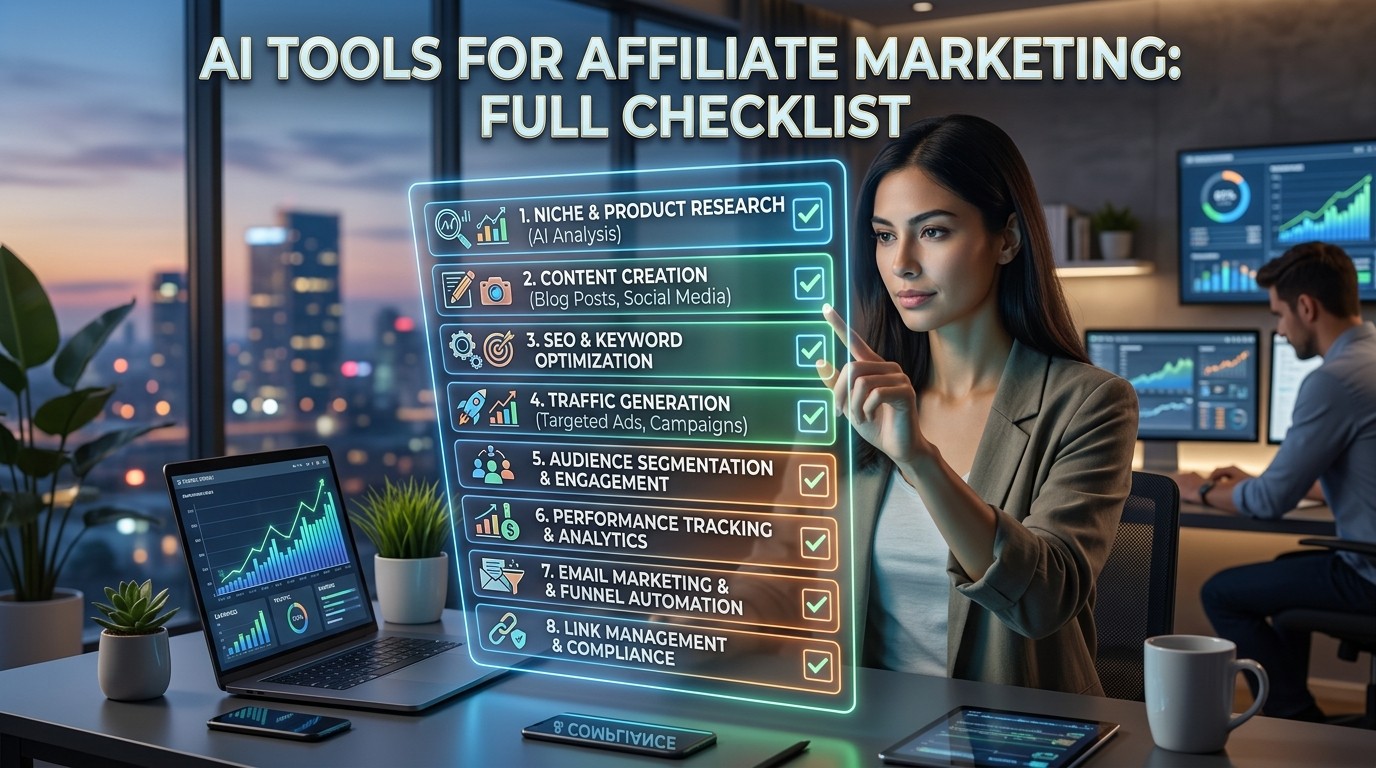
AI Tools for Affiliate Marketing help marketers research faster, write better, personalize smarter, and keep campaigns organized while staying within disclosure, quality, and policy expectations.
AI Tools for Affiliate Marketing are easiest to use when the team treats them as support for judgment rather than a replacement for it. The strongest results usually come from a mix of research, editing, testing, and human review, because both FTC disclosure rules and Google’s spam policies still apply when content is published online.
AI Tools for Affiliate Marketing are also more valuable when they fit the buyer journey instead of producing generic pages that feel interchangeable. The best affiliate work still depends on relevance, clarity, and a real reason for the reader to care, which is why content quality matters more than volume. Google has repeatedly warned against using automation, including AI, to generate pages at scale without adding value for users.
AI Tools for Affiliate Marketing are not only a content topic; they are a workflow topic. The tools should help the team move from idea to draft to review without losing the brand voice or the compliance trail. That balance becomes even more important when commissions, disclosures, and segmented messaging are part of the same campaign system.
What AI can actually do for affiliate teams
AI Tools for Affiliate Marketing can speed up the early research stage by helping teams collect topic ideas, compare angles, and outline content around a real search intent. That is useful because Google’s guidance says automation can be part of helpful content creation when it genuinely adds value for users, but it becomes a problem when it is used mainly to manipulate ranking.
AI Tools for Affiliate Marketing can also help the team sort through product features, competitor claims, and content gaps faster than manual review alone. That does not mean the tool should make the decision; it means the tool can make the next decision easier to see. When the information is organized well, the writer can spend more time on usefulness and less time on repetitive scanning.
AI Tools for Affiliate Marketing are especially useful when the team needs many asset types from the same source idea. A single product angle can become a comparison page, an email, a social post, a FAQ, or a landing-page section if the team uses the model carefully and edits the result for clarity. The value is in faster shaping, not in publishing raw output.
AI Tools for Affiliate Marketing should always be paired with human review because AI can produce fluent text that is still wrong, incomplete, or too generic. The safer workflow is to use the model for drafting and structuring, then have a person verify the claims, the tone, the disclosure language, and the usefulness of the final page.
Disclosure and compliance come first

AI Tools for Affiliate Marketing are never a substitute for proper disclosure. FTC guidance says endorsements and advertising relationships must be disclosed clearly and conspicuously when that relationship could affect how a consumer interprets the recommendation. That means affiliate status still needs to be visible even when the writing was helped by AI.
AI Tools for Affiliate Marketing should be used with a compliance mindset because the obligation to tell the truth does not disappear when a model helps write the copy. The FTC’s guidance on endorsements and influencer disclosures emphasizes that the context matters, which is why a vague or hidden note is not enough if the reader could be misled.
AI Tools for Affiliate Marketing also need a quality-control step for claims. FTC advertising guidance says claims should be supported with solid proof, especially when the copy implies performance, outcomes, or product benefits. That matters because an AI draft can sound confident even when the underlying evidence is weak or outdated.
AI Tools for Affiliate Marketing work best when compliance is built into the workflow from the start. A disclosure checklist, a claims checklist, and a review checkpoint help prevent the most common mistakes. If the final piece is public-facing, the team should assume it must survive scrutiny from readers, platforms, and regulators alike.
Research and content planning
AI Tools for Affiliate Marketing are particularly strong in the planning stage because they can help cluster topics, summarize notes, and structure outlines around audience intent. That is useful when the team wants to move quickly without losing the logic of the page. Google’s guidance is clear that content should be created for users first, not for search manipulation.
AI Tools for Affiliate Marketing can also help the team avoid the common mistake of making every page sound the same. If the tool is used well, it can suggest different angles for beginners, comparison shoppers, or readers who are already close to buying. That makes the content more useful and less repetitive, which is exactly the direction Google wants to reward.
AI Tools for Affiliate Marketing are even more valuable when they support a clear editorial process. The team can use the model to create a rough structure, then assign the final voice and proof points to a human editor. This reduces the odds of generating a lot of pages that look polished but have little substance.
AI Tools for Affiliate Marketing should help the team create fewer but better pages. That may sound slower at first, but it usually improves trust, conversion quality, and long-term search resilience. Google’s spam policies and AI content guidance both point in the same direction: scale only helps when it adds real value.
Dynamic Content and relevance
AI Tools for Affiliate Marketing become much more powerful when paired with Dynamic Content because the message can change based on the audience segment, behavior, or stage in the journey. Mailchimp defines dynamic content as content that changes depending on who receives the message, which is exactly why it works so well for affiliate funnels.
AI Tools for Affiliate Marketing can use Dynamic Content to show different offers, different proof points, or different next steps without rebuilding the whole page each time. Salesforce also describes dynamic content as content that displays according to subscriber attributes or data fields, which makes it a natural fit for segmented campaigns.
AI Tools for Affiliate Marketing should use Dynamic Content carefully, though, because too many variations can create confusion or make testing messy. The best personalization is usually the one that feels natural and helps the reader make a decision faster. Dynamic Content should improve relevance, not create a maze of tiny differences.
AI Tools for Affiliate Marketing also benefit from Dynamic Content in email. If the same message can show a segment-specific product story, a different call to action, or a different educational note, the campaign becomes more useful. That kind of flexibility helps affiliate teams keep the experience aligned with intent instead of sending one flat message to everyone.
Commission tracking and performance analysis

AI Tools for Affiliate Marketing can do a lot for reporting because commissions are only useful when the team can actually see what is working. The phrase AI Tools for Affiliate Marketing Commissions matters here because commission data is where content performance, referral quality, and profitability meet in the same place. If the numbers are unclear, the strategy is unclear.
AI Tools for Affiliate Marketing should help the team track more than just clicks. Good affiliate analysis needs conversion quality, refund patterns, segment behavior, and source-level performance so the team can understand where commissions are coming from and whether they are sustainable. The more complete the view, the easier it is to make better allocation decisions.
AI Tools for Affiliate Marketing are especially useful when they reduce spreadsheet sprawl. The goal is not to eliminate the analyst’s judgment; the goal is to make the underlying data easier to trust and easier to review. If the team spends too much time reconciling numbers by hand, they have less time to improve the funnel itself.
AI Tools for Affiliate Marketing also help the team spot anomalies faster. A sudden rise in conversions, a drop in approval rate, or a mismatch between traffic and revenue can signal a tracking issue or a quality problem. Fast detection matters because commission errors become more expensive the longer they stay hidden.
Automation and workflow discipline
AI Tools for Affiliate Marketing work best when they remove repetitive steps without removing oversight. A team can use them to build briefs, schedule drafts, organize content queues, or generate recurring reports, but the final decisions should still be reviewed by a person. That is how automation supports quality instead of replacing it.
AI Tools for Affiliate Marketing often fit well into workflow systems that are designed with the same logic as Automation Studio Software: map the steps, define the handoffs, test the process, and only then scale it. That structure helps the team turn a complicated affiliate operation into a repeatable production system.
AI Tools for Affiliate Marketing should also include clear quality checkpoints. The team should know who checks the disclosure, who checks the claims, who checks the links, and who approves publication. Without those checkpoints, automation can move too fast and publish content that is easy to produce but hard to defend.
AI Tools for Affiliate Marketing become much more valuable when they reduce the number of “forgotten” tasks. That may include updating stale links, refreshing product details, or rechecking content after an offer changes. A disciplined system creates fewer surprises and more consistent campaign health over time.
Choosing the right tool stack
AI Tools for Affiliate Marketing should sit inside a wider stack, not act as a standalone miracle. Many teams already rely on SaaS Marketing Tools for email, analytics, landing pages, or campaign planning, and AI should make those tools more useful rather than more cluttered. The best stack usually stays simple enough to manage and strong enough to support consistent publishing.
AI Tools for Affiliate Marketing should be judged by fit, not by hype. Ask whether the tool helps with research, drafting, testing, personalization, or reporting. If it does not make the team faster or the content better, it is probably adding complexity rather than value. That principle is useful in any marketing stack.
AI Tools for Affiliate Marketing also need a stable workflow around them. A good tool is easier to use when the team already has templates, editorial rules, and a review path. The model should not force the process to be reinvented. It should strengthen the process the team already trusts.
AI Tools for Affiliate Marketing are especially effective when they are evaluated in a pilot. Try one page, one offer, or one email sequence before expanding to the full program. That small test reveals whether the tool improves quality or simply speeds up the production of average work.
Scaling without losing quality

AI Tools for Affiliate Marketing can scale well only when quality controls scale with them. The bigger the output, the more important it becomes to keep your editorial standards, disclosure language, and source verification process consistent. Google’s AI content guidance and spam policies both make it clear that scale without value can become a problem.
AI Tools for Affiliate Marketing should be used with governance, not just enthusiasm. That means version control, ownership, approval rules, and periodic audits. The goal is to make sure the best-performing content is also the most trustworthy content, not just the content that was quickest to publish.
AI Tools for Affiliate Marketing should also stay adaptable as the market changes. Industrial Automation Software Trends are a useful analogy here because industrial systems often succeed through repeatability, monitoring, and controlled change rather than constant reinvention. Affiliate operations benefit from the same mindset: steady process beats chaotic scale.
AI Tools for Affiliate Marketing can still remain creative at scale if the team keeps testing. Better headlines, better segments, better calls to action, and better proof points can all be improved with AI help, but only if the final version still feels human, specific, and worth the reader’s time.
Final checklist before publishing
AI Tools for Affiliate Marketing should pass a simple final check before anything goes live: disclosure visible, claims supported, links working, copy reviewed, and audience fit verified. If any one of those is missing, the content should not be published yet. That checklist protects both the reader and the brand.
AI Tools for Affiliate Marketing work best when the review step is not treated as a formality. This is where the team catches broken wording, missing disclaimers, outdated offers, and weak value propositions. The fastest way to build trust is to publish fewer mistakes, not more content.
AI Tools for Affiliate Marketing should be evaluated regularly, because what works at one stage of growth may not work later. As the team gets bigger, the stack may need more control, better reporting, or stronger segmentation. Good tools stay useful because the process around them keeps improving.
Conclusion
AI Tools for Affiliate Marketing are most effective when they help teams research better, write more relevant content, track performance more clearly, and publish with stronger compliance habits. The real advantage is not that AI can produce more words faster. The real advantage is that it can help a team produce better work with more consistency, as long as humans still review the claims, disclosures, and fit. FTC guidance makes clear that affiliate relationships must be disclosed clearly and that marketing claims need proof, while Google’s guidance warns against using automation to create scaled content without value. That is the central takeaway: use AI to improve the workflow, not to bypass judgment. When AI supports a clean process, affiliate marketing becomes more sustainable, more trustworthy, and more effective.
Frequently Asked Questions (FAQ)
1. What should I check first when using AI in affiliate marketing?
Start with disclosure, claims, and audience fit. AI Tools for Affiliate Marketing can help draft faster, but the message still has to be honest, clear, and useful. FTC guidance says affiliate relationships should be disclosed clearly and conspicuously, so the first review should always be compliance.
2. Can AI help with content outlines?
Yes. AI Tools for Affiliate Marketing are useful for brainstorming, outlining, and grouping topics around search intent. Google says automation can be useful when it adds value for users, but it should not be used to publish lots of pages that do not help readers.
3. How does Dynamic Content help affiliate campaigns?
Dynamic Content can show different messages, offers, or proof points to different segments. Mailchimp and Salesforce both describe dynamic content as content that changes based on recipient attributes or data rules, which makes it useful for more relevant affiliate funnels.
4. Do I still need a human editor if I use AI?
Yes. AI Tools for Affiliate Marketing still need human review for accuracy, clarity, tone, and disclosure. A model can write something that sounds polished but still contains weak claims or an unclear relationship to the brand. Human review protects quality.
5. What is the safest way to handle commissions?
Use a tracked system that ties clicks, conversions, and payout logic to one reliable source of truth. AI Tools for Affiliate Marketing Commissions can help surface trends and anomalies, but the underlying numbers still need clear ownership and regular review.
6. Can AI improve SEO for affiliate pages?
Yes, if it helps create useful structure and better relevance rather than thin mass-produced pages. Google’s guidance says AI is fine when it produces helpful content, but scaled content without value can violate spam policy.
7. How do SaaS Marketing Tools fit into this?
SaaS Marketing Tools can manage email, analytics, landing pages, and reporting, while AI helps improve the content and workflow inside those tools. The best setup keeps the stack simple and the review process strong.
8. What should a small affiliate team do first?
Start with one high-value page or sequence. AI Tools for Affiliate Marketing are most useful when they are tested on a single workflow before being expanded across the whole program. That makes it easier to see whether the tool truly improves quality.
9. Is it okay to automate most of the workflow?
Yes, but not the review. AI Tools for Affiliate Marketing can automate drafts, summaries, and repetitive checks, but the team should still verify disclosures, claims, and final positioning before publishing. Automation should support quality, not replace accountability.
10. What is the one rule that matters most?
Publish only what still feels useful, honest, and specific after editing. AI Tools for Affiliate Marketing are strongest when they help the team create content that readers actually need and that the brand can confidently stand behind. That principle keeps the system sustainable.


Leave a Reply