


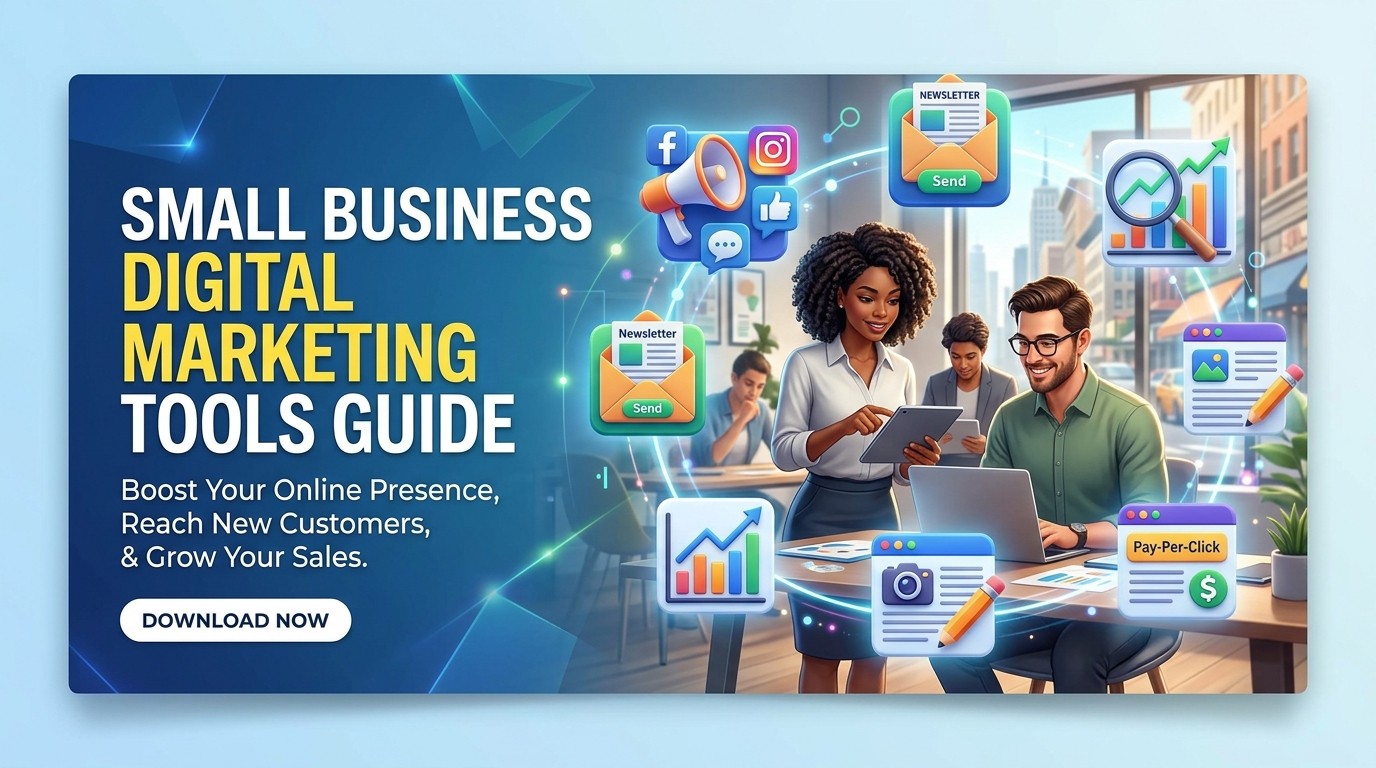
Small Business Digital Marketing Tools help owners attract customers, save time, track results, and make smarter decisions without needing a large team or expensive agency support.
Small business owners rarely suffer from a lack of effort. They usually suffer from lack of time, scattered priorities, and marketing systems that grow messy as the business grows. The right tool stack changes that reality. Instead of guessing what worked, owners can see what happens, test faster, and spend money with more confidence.
Small Business Digital Marketing Tools matter because modern buyers move through many touchpoints before they purchase. They may discover a brand on social media, compare it through search, read reviews, visit a landing page, ask a question by email, and only then decide. A small team cannot manage that journey reliably with manual work alone.
The best tools do more than automate tasks. They reduce mental load. They help business owners feel organized, which is important because confidence affects decision-making. When you can see leads, campaigns, content, and customer activity in one place, the business feels less chaotic and more controllable. That sense of control often leads to better execution.
Why small businesses need a tool system
Small Business Digital Marketing Tools are most valuable when they solve three common pain points: limited time, limited budget, and limited staff. A solo founder or a small team cannot spend all day switching tabs, copying data, or writing the same message repeatedly. A structured system gives them leverage.
Small Business Digital Marketing Tools also help teams avoid decision fatigue when every campaign, task, and customer touchpoint needs to move in the same direction.
Small Business Digital Marketing Tools also help owners avoid the trap of buying random apps without a plan. Many businesses try one tool for email, another for social media, another for analytics, and another for reporting, only to discover that nothing connects. The result is confusion instead of clarity. A smart stack should feel integrated.
Small Business Digital Marketing Tools make marketing easier to measure. Once you can connect traffic, leads, conversions, and revenue, decisions become less emotional and more practical. That is powerful for businesses that need every dollar to work hard. It also helps teams explain results to partners or investors.
How to choose the right stack
The most useful Small Business Digital Marketing Tools are the ones matched to the actual stage of the business. A new local business needs visibility and lead capture. A growing ecommerce store may need conversion optimization, remarketing, and retention support. A service company may need booking, email follow-up, and local discovery.
Small Business Digital Marketing Tools are easier to adopt when the owner defines one clear goal for each tool before paying for any upgrade.
Small Business Digital Marketing Tools should be chosen by workflow, not by hype. Start with the repeatable steps in your marketing process. Where do leads enter? How are they nurtured? Where do they convert? What happens after the sale? The right stack supports those steps instead of creating more work.
Small Business Digital Marketing Tools should also be judged by simplicity. If a tool is powerful but too complex to use consistently, it will probably fail in a small team environment. The best choice is often the one that is good enough, easy to learn, and easy to keep up to date.
Core categories every small business should consider

There is no universal stack, but most businesses need a few basic categories. The first is planning. The second is content creation. The third is publishing and scheduling. The fourth is analytics. The fifth is customer communication. The sixth is conversion support.
Small Business Digital Marketing Tools are most effective when each category has a single owner and a clear weekly review rhythm.
Small Business Digital Marketing Tools are strongest when they work together. A planning tool helps map campaigns, a content tool helps produce assets, a scheduling tool helps publish them, analytics show performance, and communication tools help convert interest into action. That sequence creates a smooth marketing engine.
Small Business Digital Marketing Tools should also include one place for storing ideas and campaign notes. Many small businesses lose momentum because good ideas live in email threads, notebooks, and random chats. A visible system protects against that loss and helps teams stay consistent over time.
Planning and strategy tools
A Digital Marketing Strategy Planning Tool is useful because strategy often fails at the execution stage, not the idea stage. Owners usually know they want more leads or more sales. What they need is a way to turn those goals into calendars, campaigns, and measurable tasks. Planning software makes that easier.
Small Business Digital Marketing Tools are easier to adopt when the owner defines one clear goal for each tool before paying for any upgrade.
The planning layer should allow visibility into priorities, deadlines, and content themes. A weekly plan works better than a vague intention. When everyone knows what is being published, who owns it, and what the goal is, the team can move faster.
A good planning system also reduces stress. Marketing feels easier when the next step is clear. That confidence matters because uncertainty often leads to procrastination. Planning tools can lower that friction by turning abstract plans into visible work.
Content creation and brand assets
Most small businesses need help creating high-quality marketing content quickly. Tools in this category may include design platforms, copywriting support, video editing apps, and asset libraries. The goal is not perfect production. The goal is consistent, appealing communication.
These tools should make the brand look trustworthy. Customers judge legitimacy fast, often within seconds. If social graphics, landing pages, and ads look inconsistent, trust can drop. Good design support helps the business appear stable, even if the team is tiny.
A useful content workflow begins with ideas, then drafts, then visuals, then review. Tools that support this flow keep content moving. They also help people collaborate without long email chains or endless revision delays.
Social media management
Social media is one of the most visible channels for small businesses, but it can become a time sink. Tools for scheduling, post creation, content approval, and performance tracking reduce the burden and make posting more reliable.
Small Business Digital Marketing Tools can turn posting from an occasional chore into a dependable publishing habit.
Small Business Digital Marketing Tools also help businesses stay consistent across platforms. Instead of posting only when someone remembers, the team can build a calendar, queue content, and review results. That consistency matters because audiences trust brands that show up regularly.
These tools can also reveal which posts create engagement and which ones disappear. That insight matters more than vanity metrics. The best social strategy is the one that creates business outcomes, not just likes.
Email marketing and lead nurturing
Email remains one of the most practical channels for small businesses. Tools that support email help owners welcome new subscribers, follow up with leads, share offers, and build repeat traffic without depending only on social platforms.
Small Business Digital Marketing Tools also protect momentum by making follow-up automatic when the owner is busy serving customers.
These tools become especially valuable when email is tied to customer behavior. A new lead may receive an introduction sequence. A customer may receive a thank-you message. A repeat buyer may receive loyalty content. That kind of personalization improves relevance and trust.
These tools should make email feel less like a manual chore and more like a system. That shift allows the business to communicate consistently even when the owner is busy handling sales, service, or operations.
Search and website performance
Search visibility matters because many customers begin with a question. Tools that help with SEO, keyword research, page speed, and on-page optimization can drive steady organic traffic over time. That traffic often costs less than paid acquisition.
These tools should help business owners see what people are searching for, which pages perform well, and where visitors leave. These insights make it easier to improve website content without guessing. Over time, search becomes a compounding asset.
These tools also support local search. For shops, clinics, service providers, and restaurants, search visibility can influence immediate foot traffic and booking behavior. That is why map listings, review management, and local landing pages matter so much.
Analytics and reporting
Marketing decisions improve when the business can measure results clearly. Tools for analytics should show the journey from traffic to leads to sales. If the business only tracks clicks, it may miss the larger story.
Small Business Digital Marketing Tools make performance easier to explain, which helps leaders make calmer and more confident decisions.
These tools should help answer practical questions. Which campaign generated the best customers? Which page kept people engaged longest? Which channel brought the highest-value leads? Those are the questions that actually support growth.
These tools also help owners avoid emotional decision-making. A campaign that feels exciting is not always profitable. A channel that looks slow might produce the best customers. Reporting brings those truths into focus.
Customer relationship and communication tools

Small businesses often win because they feel personal. Tools that support live chat, contact forms, appointment reminders, and customer follow-up help preserve that personal touch as the company grows.
These tools should make response time faster and communication more reliable. Customers appreciate quick answers. They also appreciate confirmation, reminders, and simple next steps. These small interactions reduce uncertainty and improve satisfaction.
These tools can also help businesses manage reviews and feedback. That matters because trust spreads through reputation. When people see timely responses and thoughtful communication, they assume the business is organized and dependable.
Security and trust
Digital marketing systems now hold customer data, login details, campaign assets, and financial information. These tools should therefore be selected with security in mind. A convenient tool is not enough if it exposes sensitive information.
Modern Security Software plays a major role here because small businesses are often targeted with phishing, credential theft, and account takeover attempts. A business that protects access and data can avoid costly disruption, reputation damage, and lost customer trust.
These tools should be reviewed for authentication, permissions, and data handling. Owners may not think about security until something goes wrong, but a few basic safeguards can prevent a much bigger problem later.
SaaS Security Posture Management Tools are helpful when a business uses many cloud apps. They can show where settings are weak, where sharing is risky, and where permissions are too broad. That visibility matters because tool sprawl often creates hidden vulnerability.
Building a practical Small Business Digital Marketing Tools list
A Small Business Digital Marketing Tools List should be simple enough to manage and strong enough to support daily work. The goal is not to collect software. The goal is to build a reliable workflow that helps the business acquire, nurture, and retain customers.
These tools should be grouped by purpose: planning, content, publishing, analytics, email, conversion, and security. That structure keeps the stack understandable. It also helps the owner decide which tool is essential and which one is optional.
A good list should also include ownership. Someone needs to know who updates campaigns, who checks performance, and who handles access. These tools work best when responsibilities are clear.
Mistakes to avoid
The biggest mistake is buying tools before defining the process. These tools cannot fix a broken workflow. If the business does not know what content it needs, who it serves, or how leads are followed up, the stack will only add noise.
Another mistake is overcomplicating the system. These tools should reduce work, not multiply it. If the owner needs training every time a task is repeated, the tool is probably too heavy for the business.
A third mistake is ignoring adoption. Even the best software fails if the team does not use it consistently. The right choice is the one that people will actually open, update, and trust every week.
Budget-friendly buying logic
Small businesses need tools that return value quickly. These tools should be evaluated using practical questions: Does this save time? Does it improve quality? Does it help us sell more? Does it reduce manual work?
These tools are often available in freemium or low-cost versions, which makes experimentation easier. That is useful, but the business should still be careful not to accumulate subscriptions that overlap. Tool waste can quietly become a monthly problem.
A strong buying rule is to start with one core tool per job. Expand only after the workflow proves useful. These tools are most cost-effective when they are chosen intentionally and used regularly.
How the stack supports growth
These tools help growth by making the business more consistent. More consistent posting leads to better visibility. Better visibility creates more opportunities. Better follow-up improves conversion. Better reporting improves decision-making. The compounding effect is significant.
These tools also make it easier to scale without adding too much headcount. A small team can only do so much manually, but software creates leverage. That leverage gives the company room to focus on strategy and service quality.
When the stack is aligned, marketing feels less like a scramble and more like an operating system. That is the real value of these tools. They support a business that wants to grow without losing its clarity.
Recommended stack logic by business type
A local service business usually needs scheduling, contact capture, local SEO, review management, and email follow-up. These tools in that case should focus on trust, discovery, and response speed.
An ecommerce business often needs product content, email automation, analytics, retargeting, and conversion optimization. These tools for ecommerce should emphasize purchase behavior and repeat sales.
A consultant or agency may need lead magnets, landing pages, appointment tools, email sequences, and proposal support. These tools in that case should focus on authority and pipeline building.
Implementation checklist
Start by listing the exact tasks your team performs every week. Then map each task to one tool. Remove anything that does not serve a real workflow. These tools should fit the business, not the other way around.
Then set clear rules for ownership, frequency, and review. A tool only becomes valuable when it is part of a routine. These tools are most effective when they are treated as habits, not experiments.
Finally, review the stack every few months. Business needs change, channels change, and teams change. These tools should evolve as the business grows.
Extra considerations for lean teams

When a business has only a few people, the strongest systems are the ones that reduce decision fatigue. Tool choice matters less than tool clarity. If everyone knows where to find campaign data, how to launch a post, and where leads are stored, the team moves faster and makes fewer mistakes.
Lean teams should also avoid building too many custom workflows too early. Simplicity is an asset. A simple process is easier to teach to a new hire, easier to audit, and easier to improve later. This matters because small businesses usually grow through repetition before they grow through sophistication.
Documentation is another underestimated advantage. A short internal guide can save hours of repeated explanation. Even a one-page checklist for weekly tasks can improve consistency. When the process is documented, the team does not have to rely on memory alone.
What to prioritize in the first 90 days
In the first month, focus on visibility and organization. Set up the core accounts, connect the website, and make sure leads are captured properly. The goal is to stop losing opportunities to manual chaos.
In the second month, improve communication. Create a basic email sequence, a response process, and a content calendar. These steps help the business follow up faster and present a more professional experience.
In the third month, review results. Look at traffic, leads, sales, and workload. Then remove any tool that is not being used. Small Business Digital Marketing Tools should be introduced gradually so adoption feels manageable rather than overwhelming.
The role of consistency
Marketing success usually comes from repetition. One great post or one great campaign rarely changes everything. Consistency is what builds familiarity, and familiarity builds trust. The right tools make that consistency possible even for busy owners.
When the system is stable, the business can show up even on difficult weeks. That reliability often matters more than occasional brilliance. Customers remember brands that stay present and responsive.
Consistency also improves learning. If the process is repeated, the data becomes more useful. The business can tell what works, what fails, and what should be scaled. That is one of the biggest hidden benefits of a good stack.
Final operating principle
A strong tool system should make the business feel calmer, not busier. It should reduce confusion, improve follow-up, and make growth easier to measure. If a tool does not do that, it may be adding overhead instead of leverage.
The best decisions are usually the boring ones done well. Choose a clear process, choose tools that support it, and keep the stack lean enough to manage. Over time, that discipline compounds into better marketing and stronger business results.
Conclusion
Small Business Digital Marketing Tools do not need a huge software budget to market effectively. They need a simple, dependable system that helps them plan, create, publish, measure, and follow up without wasting time. The right mix of tools creates leverage by reducing manual work and making decisions clearer. It also helps owners maintain a professional presence, build trust, and respond faster to customer needs. When the stack is selected intentionally and reviewed regularly, marketing becomes more predictable and far less stressful. The result is not just better activity. It is better execution, better customer experience, and better long-term growth for a business that must make every effort count.
Frequently Asked Questions (FAQ)
1. What are these tools used for?
They help small businesses organize marketing tasks, create content, publish campaigns, track results, and communicate with customers.
2. Why do small businesses need a planning tool?
A planning tool turns goals into deadlines, tasks, and campaigns that are easier to manage and measure.
3. What should be in a Small Business Digital Marketing Tools checklist?
Planning, design, social scheduling, email, analytics, communication, and security tools are common categories.
4. Are security tools really necessary?
Yes. Small businesses store customer data, account access, and marketing assets that need protection.
5. What does a strategy planning tool do?
It helps map campaign goals to actual work, so strategy becomes easier to execute.
6. How many tools should a small business start with?
Start with the fewest tools needed to cover the core workflow, then expand only when the process is working.
7. Why mention security software in a marketing guide?
Because marketing systems often contain sensitive data and login credentials that should be protected.
8. What are posture management tools used for?
They help identify cloud security gaps, risky settings, and excessive permissions across software tools.
9. How often should the stack be reviewed?
Review it every few months, or whenever the business changes goals, channels, or team structure.
10. What is the biggest mistake small businesses make?
They often buy too many tools before defining the process, which creates confusion instead of efficiency.


Leave a Reply