


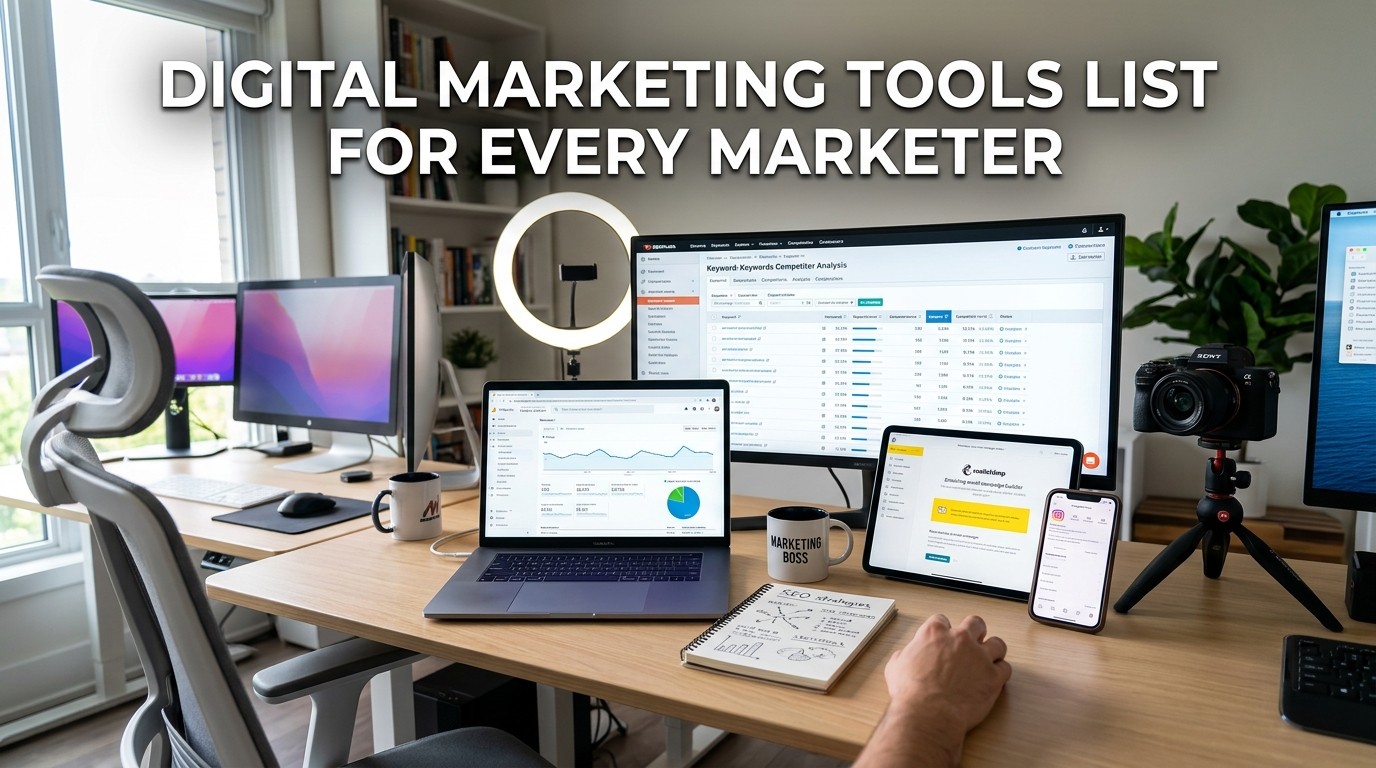
The Digital Marketing Tools List below helps marketers choose practical software for planning, publishing, optimizing, measuring, and scaling campaigns without wasting time, budget, or attention.
A strong Digital Marketing Tools List is not just a shopping list of software. It is a decision system that helps marketers reduce friction, improve consistency, and move faster with less guesswork. The best teams do not collect tools because they are trendy; they collect them because each one solves a real problem in the marketing workflow. When a stack is built with intention, the team spends less energy switching between tabs and more energy creating demand, improving conversion, and understanding customers.
A weak stack creates hidden costs. People duplicate work, reports drift out of sync, and campaigns become difficult to compare. A thoughtful Digital Marketing Tools List solves that by aligning tools with clear stages of the journey: planning, research, production, distribution, measurement, and optimization. That alignment matters because marketing success usually comes from small, repeated improvements rather than one dramatic win. The right platform choice can speed up those improvements and give the team a clearer sense of what is actually working.
What marketers really need from tools
At the core, a useful Digital Marketing Tools List should support speed, clarity, and accountability. Speed matters because marketing moves quickly and teams need to test ideas before the market changes. Clarity matters because data without context is just noise. Accountability matters because every campaign should be traceable from idea to outcome. When tools support those three needs, the entire team becomes more effective.
The best software also fits human behavior. People are more likely to use tools that are intuitive, not overly cluttered, and easy to share across roles. A Digital Marketing Tools List should therefore include systems that reduce cognitive load. If a platform requires too many steps before value appears, adoption drops. If reporting is hard to interpret, stakeholders lose confidence. If collaboration is messy, execution slows. Great tools do more than process data; they help teams make better decisions together.
Categories every marketing stack should cover
A complete Digital Marketing Tools List usually spans a few essential categories. First comes strategy and planning, where teams define goals, audiences, calendars, and priorities. Then comes content creation, where assets such as copy, images, and video are produced. After that comes distribution, including email, social, search, and paid media. Measurement tools follow, showing what happened and where to improve. Finally, automation and customer relationship systems keep the process efficient over time.
The reason this structure works is simple: marketing is a system, not a one-off campaign. A complete Digital Marketing Tools List should support the full loop from idea to outcome. If one part of the loop is missing, the team can still work, but it will work with more friction and less confidence. That is why the smartest buyers think in workflows rather than individual apps.
| Category | What it helps with | Why it matters |
|---|---|---|
| Strategy | Goals, planning, calendars | Keeps the team aligned |
| Content | Writing, design, video | Improves speed and quality |
| Distribution | Email, social, ads | Reaches the right audience |
| Analytics | Tracking, reporting, attribution | Shows what drives results |
| Automation | Workflows, follow-ups, triggers | Saves time and reduces errors |
Planning before buying
The easiest way to overspend is to buy software before defining the problem. A Digital Marketing Tools List should begin with questions, not with product demos. What part of the process is slow? What task gets repeated too often? What insight is missing? What causes confusion between teams? Once those pain points are clear, it becomes much easier to identify the right category of tool.
Planning also prevents feature overload. Many platforms promise everything, but not every feature is useful for every team. A Digital Marketing Tools List built on real operational needs will always outperform a stack chosen for novelty. For example, a small team might need one platform that handles planning and collaboration well, while a larger team may need more specialized systems for analytics, automation, and segmentation. Clarity first, software second.
Strategy and calendar tools
A Digital Marketing Tools List should always include at least one place where strategy lives. That might be a collaborative doc system, a project tracker, or a campaign calendar platform. The goal is to keep goals, deadlines, content themes, and owners visible to the whole team. When that visibility is missing, tasks get forgotten and priorities become inconsistent.
The strongest planning tools are not necessarily the most complex. They are the ones that make decisions obvious. A Digital Marketing Tools List should include systems that let marketers see what is coming next, what is already in progress, and what needs approval. That visual order helps teams reduce chaos. It also helps leaders spot bottlenecks before they turn into missed launches or rushed work.
A Digital Marketing Strategy Planning Tool can be especially helpful when campaigns span multiple channels and stakeholders. It brings structure to quarterly goals, campaign themes, launch schedules, and measurement checkpoints. Instead of planning in scattered documents, the team can centralize the process and keep execution tied to strategy.
Content creation and collaboration
Content is where strategy becomes visible. A Digital Marketing Tools List should support copywriting, design, video editing, review cycles, and asset storage. The real advantage of these tools is not just production speed. It is consistency. When teams can access templates, brand assets, and version history in one place, quality improves and mistakes drop.
Content tools also shape morale. People do better work when the process feels organized and predictable. A Digital Marketing Tools List that includes collaborative creation platforms helps reduce back-and-forth, which means more time is spent improving the message itself. That matters because content is often the first thing prospects notice. If the message feels weak, everything downstream suffers.
Even in technical industries, presentation matters. Some marketers study Edge Computing Use Cases and Telecom Edge Computing Use Cases to understand how distributed systems make fast decisions near the source. The same logic applies here: when content moves through a clear workflow, decisions happen faster and with less friction.
SEO and keyword research
Search visibility remains one of the most durable sources of intent-driven traffic, so any Digital Marketing Tools List should include SEO research tools. These platforms help marketers discover demand, understand competition, and build content around what people are actually searching for. That is valuable because search traffic often converts well when the content matches user intent.
Keyword research tools are especially useful for identifying gaps. They show which topics already have demand and where competitors are weak. A Digital Marketing Tools List that includes SEO software gives the team a way to prioritize topics with clear business potential. Instead of guessing, marketers can build content around measurable opportunity.
SEO tools also support content maintenance. Rankings change, competitors publish new pages, and search intent shifts over time. A strong Digital Marketing Tools List should include software that tracks performance and flags when pages need updates. That ongoing feedback helps marketers protect the value of content they have already created.
Social media management
Social platforms reward speed, consistency, and relevance. A Digital Marketing Tools List should include tools that help schedule posts, monitor engagement, organize comments, and analyze performance across networks. Without that support, social teams spend too much time manually posting and too little time improving strategy.
The best social tools make it easier to test content types. A Digital Marketing Tools List should support different formats, timing patterns, and audience segments so teams can see what resonates. Social media is often a conversation rather than a broadcast, so the platform should help marketers listen as much as they speak.
These tools also help protect the brand. When multiple people manage social accounts, approvals and permissions matter. A Digital Marketing Tools List that includes social governance features reduces the risk of inconsistent messaging or accidental publishing errors. That calm, controlled process builds trust inside the team and outside it.
Email marketing and lifecycle communication
Email remains one of the most reliable channels for nurturing relationships. A Digital Marketing Tools List should include email software that supports segmentation, automation, testing, and deliverability monitoring. The value of these tools is not only sending messages but sending the right message to the right person at the right time.
Lifecycle communication matters because not all users are at the same stage. Some are new, some are active, and some need re-engagement. A Digital Marketing Tools List that supports lifecycle flows helps marketers tailor messages to behavior rather than relying on one-size-fits-all campaigns. That usually leads to stronger engagement and fewer unsubscribes.
The best email tools also reveal patterns. They show which subject lines get opened, which offers drive clicks, and which sequences build trust. A Digital Marketing Tools List should therefore include platforms that make testing easy. If each experiment takes too much effort, teams stop learning. If testing is simple, improvement becomes part of the rhythm.
Analytics and reporting
A Digital Marketing Tools List is incomplete without strong analytics. Marketers need to know where traffic comes from, how people behave, which campaigns convert, and where the funnel leaks. Analytics software turns those questions into evidence. That evidence helps teams avoid guesswork and focus on the channels that actually move the business.
Good reporting tools also improve trust. When results are easy to explain, stakeholders feel more confident in the marketing team. A Digital Marketing Tools List that includes clear dashboards and repeatable reports helps everyone understand progress. That is especially useful in organizations where leadership wants quick visibility into return on investment.
Analytics should not only describe the past. A useful Digital Marketing Tools List includes tools that help teams anticipate future behavior through segmentation, attribution, and cohort analysis. Those methods help marketers see what is likely to happen next and adjust earlier rather than later.
Paid media and conversion
Paid advertising often drives the fastest short-term growth, but only when it is managed carefully. A Digital Marketing Tools List should include ad management and conversion tools that help teams test audiences, creatives, and offers without losing control of spend. The goal is not to buy traffic blindly. It is to buy learning efficiently.
Conversion tools matter because traffic without action is wasted opportunity. A Digital Marketing Tools List should therefore include landing page builders, form tools, heatmaps, and A/B testing platforms. These tools help marketers understand where visitors hesitate and what encourages action. Small improvements in conversion can create major gains in efficiency.
Paid media teams also benefit from cleaner tracking. A Digital Marketing Tools List with solid attribution and event tracking tools helps reduce confusion about which channel deserves credit. That clarity supports better budget decisions and faster optimization.
Automation and workflows
Automation is one of the strongest ways to reduce repetitive work. A Digital Marketing Tools List should include systems that trigger follow-ups, route leads, notify teams, and sync data across platforms. When these processes are automated, marketers spend more time thinking and less time copying information from one place to another.
The best automation feels invisible. A Digital Marketing Tools List should make tasks happen at the right moment without requiring constant manual intervention. For example, a lead can be tagged, moved into a workflow, and handed to sales automatically. That type of coordination reduces missed opportunities and strengthens the customer experience.
Automation should still be controlled carefully. A Digital Marketing Tools List that includes workflow tools must also include checks for accuracy and relevance. If automation is poorly configured, it can send the wrong message at the wrong time. Good systems save time without sacrificing judgment.
CRM and lead management
Customer relationship tools are central to long-term growth. A Digital Marketing Tools List should include CRM platforms that track interactions, organize contacts, and support sales alignment. Marketing does not end when someone clicks. It continues through follow-up, nurturing, and relationship building.
CRM software helps teams segment users by behavior, source, industry, or stage. A Digital Marketing Tools List that includes that capability makes campaigns more personal and more effective. It also helps sales and marketing speak the same language. That shared structure reduces confusion and makes handoffs smoother.
The best CRM tools make data usable, not just stored. A Digital Marketing Tools List should prioritize systems that help teams take action on what they know. If contacts are visible but not organized, the tool becomes a database instead of a growth engine.
Visual design and brand consistency
Design tools support credibility. A Digital Marketing Tools List should include systems for graphics, presentations, social visuals, and brand assets. When content looks polished and consistent, it builds confidence. People often judge quality quickly, so visual alignment is more than decoration. It is part of persuasion.
Design software is especially helpful for teams working across many channels. A Digital Marketing Tools List with shared templates, asset libraries, and approval features helps maintain a consistent brand voice. That consistency reduces confusion and makes campaigns feel more intentional.
Marketers who manage multiple brands or product lines especially benefit from visual systems. A Digital Marketing Tools List that keeps fonts, colors, and layouts aligned can save time and improve recognition. Strong design does not just attract attention. It makes the message feel trustworthy.
Video creation and short-form content
Video is now a core marketing format, not a bonus channel. A Digital Marketing Tools List should include tools for editing, subtitling, clipping, and publishing video content. Even simple tools can have a large impact because short-form video often communicates value faster than text alone.
The most useful video tools help teams repurpose content efficiently. A Digital Marketing Tools List that supports clipping long recordings into shorter assets can increase output without multiplying effort. That is important because many teams have limited time but still need to feed social, email, and paid channels.
Video tools also help marketers learn from audience response. A Digital Marketing Tools List should include platforms that reveal watch time, drop-off, and engagement patterns. Those signals show which hooks and messages deserve more investment.
Team size and stack choice
Not every team needs the same stack. A small team should prioritize simplicity, while a larger team may need deeper specialization. A Digital Marketing Tools List should therefore be shaped by resources, goals, and operating style. The right solution for one company may be wrong for another.
Small teams often need flexibility and broad functionality. That is why Small Business Digital Marketing Tools matter so much: they help lean teams do more with less, without creating unnecessary complexity. Larger teams may need stronger integrations, governance, and reporting. In both cases, the tool should match the team’s actual capacity to use it well.
One useful rule is to prefer tools that solve multiple adjacent problems before layering on extras. A Digital Marketing Tools List works best when each platform earns its place. If a tool is redundant, underused, or confusing, it creates drag instead of value.
Cost, return, and hidden savings
Software cost is not just the subscription fee. A Digital Marketing Tools List should be evaluated by total value, including time saved, mistakes avoided, and faster decisions. A cheaper tool can become expensive if it creates manual work. A more expensive tool can be worth it if it eliminates repeated labor and improves results.
ROI should be considered broadly. A Digital Marketing Tools List that shortens production time, increases conversion, or improves reporting may free up more value than it costs. This broader view helps leaders make smarter decisions. The question is not “Which tool is cheapest?” The question is “Which tool improves the whole system most?”
Hidden savings often come from reduced chaos. When tools integrate properly, teams avoid duplicate entry, version confusion, and missed follow-ups. A strong Digital Marketing Tools List lowers friction in ways that are easy to overlook but valuable over time.
Building a balanced stack
A balanced stack is better than an overloaded one. A Digital Marketing Tools List should cover the full funnel without repeating the same function three different ways. Too many overlapping tools create confusion, not strength. Fewer, well-chosen tools often produce better outcomes because they are easier to maintain.
Balance also means choosing tools that fit one another. A Digital Marketing Tools List should connect planning, production, publishing, and measurement in a logical flow. If the stack is fragmented, the team spends more time fixing the process than improving the message. Integration is not a luxury. It is the glue that makes the stack usable.
The smartest marketers review their stack regularly. A tool stack should evolve as the team matures. What worked at a small scale may no longer work later. Periodic review keeps the stack aligned with goals rather than history.
A practical framework for choosing tools
Before buying anything, map the workflow. A Digital Marketing Tools List should answer the question, “What happens before, during, and after this task?” If the tool does not improve that chain, it may not belong. This framework protects teams from impulse buying and helps them spend on problems rather than features.
Next, look at adoption. A Digital Marketing Tools List only works if people actually use it. If the interface is confusing or the setup is painful, the team will create workarounds. That undermines the value of the tool and makes reporting less reliable. Ease of use is often as important as feature depth.
Finally, test for scale. A Digital Marketing Tools List should not only solve today’s issue. It should still work when more campaigns, more users, and more data arrive. A tool that fits now but breaks later is a temporary fix, not a long-term investment.
Where strategy and execution meet
A tool stack is strongest when it supports good thinking. A Digital Marketing Tools List should not replace strategy; it should help execute it consistently. The best teams use software to clarify priorities, not to hide weak decisions. That mindset keeps the stack focused on real outcomes.
This is why marketers often compare tools to a system rather than a collection. A Digital Marketing Tools List should help teams move from idea to action with fewer handoffs and less drift. The clearer the workflow, the easier it is to stay focused on the audience instead of the mechanics.
There is also a useful lesson from operational fields that rely on distributed decision-making: systems work best when local decisions are fast and well coordinated. In marketing, the same principle means the right tool should make decisions easier at the moment they need to be made.
Suggested workflow by stage
A practical Digital Marketing Tools List usually follows a sequence. First, define the campaign in a planning tool. Then create the assets with design, copy, and video software. Next, publish through social, email, and ad platforms. After launch, review analytics and adjust based on performance. Finally, automate what can be repeated and archive what has been learned.
This sequence helps marketers think in loops. A Digital Marketing Tools List becomes more valuable when each stage feeds the next. For example, analytics can inform better content, content can support better ads, and ads can create data for smarter segmentation. That cycle is where compounding improvement comes from.
The more disciplined the workflow, the more useful the tools become. A Digital Marketing Tools List should reduce uncertainty, not add complexity. When the stack is organized around process, teams can move faster with more confidence.
Conclusion
A strong marketing stack is not about owning every possible platform. It is about choosing a Digital Marketing Tools List that supports the real work of planning, creating, publishing, measuring, and improving. When the stack fits the team, it saves time, reduces mistakes, and makes results easier to understand. The best tools are the ones people actually use because they solve real problems in a clean and repeatable way. As your strategy evolves, review the stack, remove overlap, and keep only the software that helps your team execute better. The right mix of tools does more than improve productivity; it creates a calmer, clearer, and more effective marketing operation.
Frequently Asked Questions (FAQ)
1. What should be included in a Digital Marketing Tools List?
A practical list usually includes planning tools, content creation tools, SEO software, social media management, email automation, analytics, CRM, and conversion tools.
2. How many tools does a marketing team really need?
There is no fixed number. The right amount depends on team size, workflow, and complexity. Most teams do better with a smaller, well-integrated stack than with too many overlapping tools.
3. Are free tools enough?
Free tools can be useful for early-stage work, but they often have limits in automation, collaboration, and reporting. They are a good starting point, not always a long-term solution.
4. What is the most important category?
That depends on the bottleneck. Some teams need better planning, others need analytics, and others need automation. The most important category is the one that removes the biggest friction point.
5. How do I choose tools for a small team?
Focus on simplicity, ease of use, and all-in-one functionality. Small teams often benefit from tools that cover multiple tasks without requiring many integrations.
6. How do I know if a tool is worth the cost?
Measure time saved, errors reduced, performance improved, and reporting clarity. A tool is worth the cost if it makes the team faster or more effective in a measurable way.
7. Should all tools integrate with each other?
Not every tool must integrate directly, but the core systems should connect cleanly. Planning, CRM, analytics, and automation are especially important to link together.
8. What is the biggest mistake teams make?
The biggest mistake is buying tools before defining the workflow problem. That usually leads to wasted budget, low adoption, and overlapping features.
9. How often should the stack be reviewed?
Review it at least quarterly or whenever the team changes goals, channels, or headcount. A stack should evolve with strategy, not stay frozen in time.
10. Can one tool replace an entire stack?
Sometimes a platform can cover several needs, especially for smaller teams. But no single tool is ideal for every task. The best stack is the one that fits your workflow and helps the team execute with confidence.


Leave a Reply