


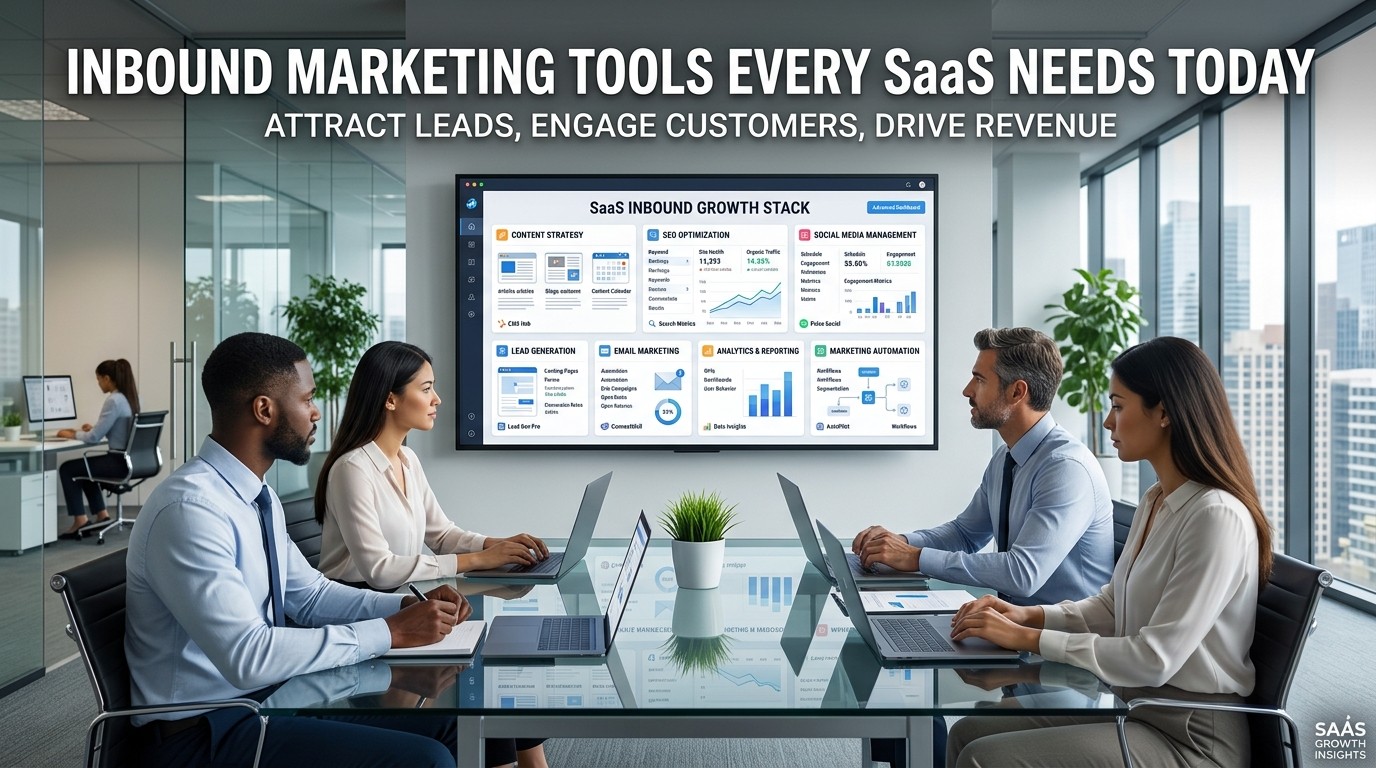
Inbound Marketing Tools help SaaS teams turn content, automation, and follow-up into a repeatable growth engine that attracts qualified buyers, nurtures trust, and supports steady pipeline growth.
Inbound Marketing Tools matter for SaaS because software buyers rarely convert on the first touch. They read, compare, revisit, and ask for proof before they commit. That means the first job of the stack is not to close instantly; it is to keep the conversation alive long enough for trust to form. Inbound Marketing Tools help the team do that by connecting content, capture, and follow-up in a way that feels useful rather than loud.
Inbound Marketing Tools also solve a major SaaS problem: people forget. Even a strong product can disappear from memory if the brand does not stay visible in a helpful way. That is why the best teams build educational assets, answer questions early, and make the next step obvious. Inbound Marketing Tools create that bridge between curiosity and action.
Inbound Marketing Tools are especially important when the product is technical, abstract, or crowded by competitors. The buyer wants proof, examples, and confidence before they commit. If the site can educate first and sell second, the funnel feels calmer. That calmer experience often leads to stronger conversion because the prospect does not feel rushed.
Why SaaS needs one connected system
Inbound Marketing Tools work best when the SaaS team understands the buyer journey. A new visitor is not the same as a returning evaluator, and a trial user is not the same as a customer comparing plans. Each stage needs a different message, a different asset, and often a different trigger. Inbound Marketing Tools should support those stages rather than force everyone through the same path.
Inbound Marketing Tools also help teams prioritize intent. If someone is reading high-level educational content, they may need a beginner explanation and a low-friction offer. If someone is on a pricing page, they may need proof, comparisons, or a demo request. The same site can serve both groups well if the flow is designed properly.
Inbound Marketing Tools become even more valuable when the SaaS company wants predictable growth. Predictability comes from repeatable systems, not random wins. When the team knows which content attracts which audience and which follow-up turns interest into meetings, the whole operation becomes easier to manage.
Content is still the engine
Inbound Marketing Tools usually start with content, because content is how most SaaS brands earn trust before a salesperson enters the picture. Blog posts, comparison pages, guides, case studies, webinars, and product walkthroughs all work because they answer the questions buyers already have. The content does not need to be flashy; it needs to be useful enough to stay in the buyer’s mind.
Inbound Marketing Tools are stronger when the content is organized around problems rather than features. A buyer often begins with pain: slow reporting, messy handoffs, low visibility, or too much manual work. If the site shows that it understands the problem, the reader is more likely to stay. If the content only lists features, the buyer may leave before seeing the relevance.
Inbound Marketing Tools also make content easier to reuse. One good guide can support social posts, email nurture, sales follow-up, and webinar topics. That reuse matters because SaaS teams need leverage. The more a single asset can do, the better the marketing system performs over time.
Email nurture keeps the interest alive

Inbound Marketing Tools are not complete without email nurture. SaaS buyers rarely buy on the first visit, so the follow-up sequence matters as much as the first page view. A good sequence keeps the brand present without becoming annoying. It reminds the buyer why they were interested, shows a useful next step, and makes return visits easier.
Inbound Marketing Tools should support segmentation in email. Someone who downloaded a beginner guide should not receive the same message as someone who requested pricing. The more relevant the email, the more likely the recipient is to open, click, and respond. Relevance is the difference between a useful sequence and a generic drip.
Inbound Marketing Tools also help teams understand timing. The right email sent at the wrong time can still underperform, while a simple message sent after a meaningful action can perform very well. Timing, relevance, and clarity are the three ingredients that make nurture feel human.
Forms and landing pages must stay simple
Inbound Marketing Tools become more powerful when forms and landing pages are clean. A page that asks for too much information too soon usually loses visitors. A page that keeps the request simple often converts better because the friction is lower. SaaS teams should think carefully about what the visitor is ready to give at each stage.
Inbound Marketing Tools should also help the team reduce clutter on landing pages. If the page tries to explain everything, it can overwhelm the reader. A strong page focuses on one promise, one audience, and one next step. That kind of clarity makes it easier to say yes.
Inbound Marketing Tools work well when forms are connected to the right offer. A demo request, a checklist, a template, and a trial signup are not the same thing. The best performance usually comes from matching the form to the visitor’s level of intent. The cleaner the offer, the stronger the conversion path.
Automation should feel helpful, not robotic
Inbound Marketing Tools are most effective when they support automation without making the experience feel robotic. A new lead might trigger a welcome sequence, a trial user might trigger onboarding messages, and a pricing-page visitor might trigger a sales alert. The key is to make the workflow feel responsive, not mechanical.
Inbound Marketing Tools benefit from this automation because the team can respond faster than manual follow-up allows. That speed matters in SaaS, where interest can fade quickly if nobody replies or if the next step is unclear. Automation keeps the conversation warm while the lead is still engaged.
Top Automation Software often becomes part of this conversation because teams want tools that connect marketing, sales, and operational workflows in one stack. The best setup is not the one with the most bells and whistles; it is the one that reduces wasted effort and keeps the buyer journey moving.
Marketing and sales must agree on readiness

Inbound Marketing Tools also need alignment between marketing and sales. If marketing thinks a lead is ready and sales disagrees, the funnel becomes noisy. Shared definitions, handoff rules, and feedback loops make the system stronger. That is why alignment is not a soft issue; it is a revenue issue.
Inbound Marketing Tools can support alignment by showing which assets influenced the lead, which pages the buyer viewed, and which actions signaled interest. That context helps sales start the conversation at the right level instead of repeating basic information. It also helps marketing understand which campaigns produce actual opportunities.
Marketing Alignment Tools matter because the same lead can be viewed very differently by different teams. One team may celebrate volume while another team values fit. Inbound Marketing Tools should help close that gap by making the buyer journey visible and consistent across departments.
Measurement should focus on real movement
Inbound Marketing Tools are easier to improve when the team tracks the right metrics. Opens and clicks matter, but SaaS growth depends more on trial starts, demo requests, activation, and pipeline contribution. If the team measures only vanity signals, it may think the strategy is working when it is not.
Inbound Marketing Tools should therefore be tied to reporting that answers practical questions. Which content brings qualified visitors? Which forms convert best? Which email sequence gets replies? Which pages support the highest-value opportunities? Those questions make the data useful for decision-making.
Inbound Marketing Tools also benefit from shorter review cycles. A monthly check may be too slow for a fast-moving SaaS campaign, while a weekly check can catch problems early enough to fix them. The more quickly the team learns from the data, the more efficiently the funnel improves.
Scaling means staying organized
Inbound Marketing Tools scale best when the company treats them like a system rather than a set of random apps. A small SaaS team may only need a few strong pages and one nurture path, but as the company grows, the stack has to support multiple segments, multiple products, and multiple buying journeys.
Inbound Marketing Tools should also support content libraries. A growing SaaS brand usually needs pillar pages, comparison posts, product pages, onboarding content, and educational resources that all work together. If every asset is isolated, scaling becomes harder. If the assets are connected, the system compounds.
Industrial Automation Software may seem unrelated, but it offers a useful lesson: the best systems are designed for repeatability, visibility, and control. SaaS marketing works the same way when the team builds repeatable content and response loops instead of reinventing every campaign from scratch.
Choosing the right stack

Inbound Marketing Tools should be chosen based on fit, not hype. The best platform is the one that supports the company’s content strategy, email needs, reporting habits, and handoff process without creating too much friction. A very large stack can look impressive and still underperform if the team does not use it consistently.
Inbound Marketing Tools also become easier to manage when the team knows its own audience. A product-led SaaS, a sales-led SaaS, and a hybrid model will not need the exact same setup. That is why a B2B Marketing Tools Expert can be valuable: the right specialist helps the team choose tools around the buyer journey instead of around feature lists.
Inbound Marketing Tools are strongest when they are maintained with discipline. Good tagging, clean segments, updated offers, and regular testing matter more than a long tool list. If the system stays simple enough for the team to operate well, the results usually improve.
A healthy SaaS marketing team also keeps one eye on messaging consistency across the website, the product, and the sales team. When visitors hear the same promise in each place, they trust the brand faster, and the transition from research to trial feels more natural and less forced. That consistency is often what separates a curious visitor from a confident buyer, because the experience feels organized, believable, and worth returning to during the next evaluation step before making a decision.
Final perspective
Inbound Marketing Tools matter most when they make the whole SaaS journey feel clearer for the buyer and easier for the team. The right setup turns one website visit into a continuing conversation, and that conversation becomes the basis for trust, trial, and revenue. Inbound Marketing Tools do not need to be flashy to be effective; they need to be aligned, useful, and repeatable.
Inbound Marketing Tools work best when they connect content, automation, segmentation, and reporting into one path. That path should help the buyer move from awareness to interest to action without unnecessary friction. When the system does that well, the company spends less time chasing leads and more time converting the right ones.
Inbound Marketing Tools are ultimately a leverage play. They help SaaS brands create growth that does not depend on constant manual effort. If the content is strong, the follow-up is timely, and the data is readable, the marketing machine becomes more dependable over time. The best teams revisit assumptions quarterly because buyer expectations, channels, and product positioning shift faster than most roadmaps admit.
Conclusion
The strongest inbound system is the one the team can actually maintain. If content answers real buyer questions, automation follows the right signals, and reporting stays clear, the funnel becomes easier to trust. SaaS growth then stops depending on constant manual follow-up and starts depending on a repeatable process that keeps learning. Inbound Marketing Tools work best when they reduce friction for the buyer and reduce busywork for the team. When those two things happen together, the stack becomes easier to scale, easier to explain, and easier to improve over time across campaigns, quarters, launches, and team changes overall consistently.
Frequently Asked Questions (FAQ)
1. What are Inbound Marketing Tools in SaaS?
They are the software and systems that help SaaS teams attract visitors, capture leads, nurture interest, and turn that interest into trials, demos, and revenue. The best setups connect content, automation, forms, and reporting so the buyer journey feels smooth rather than fragmented.
2. Why do SaaS companies need them?
SaaS buyers usually need more education and trust before they buy. Inbound Marketing Tools help the company answer questions early, stay visible after the first visit, and guide people toward the next step without overwhelming them.
3. What should the first tool do?
The first tool should help the team capture attention in a useful way. That might mean content distribution, a clean landing page, a form, or a lead magnet. The key is to make the first interaction feel relevant and low friction.
4. How do these tools support conversions?
They improve conversions by reducing confusion and increasing trust. When the visitor sees a clear message, a relevant offer, and a simple next step, they are more likely to act.
5. Are automation tools enough on their own?
No. Automation helps, but it works best when paired with strong content, clear segmentation, and good follow-up. A fast system is not useful if the message is weak or the offer is unclear.
6. What matters more: traffic or lead quality?
Lead quality matters more for most SaaS teams. Traffic is useful, but if the visitors are not a fit, the funnel will stay weak. The best tools help attract the right people, not just more people.
7. How do marketing and sales stay aligned?
They stay aligned by agreeing on lead definitions, handoff rules, and what counts as readiness. Shared reporting and regular feedback help both teams see the same buyer journey.
8. Should every SaaS company use the same stack?
No. A product-led company, a sales-led company, and a hybrid company will not need the same setup. The best stack depends on audience, product complexity, and growth motion.
9. What is the biggest mistake teams make?
The biggest mistake is collecting too many tools without a clear system. A big stack can create more confusion than value if the team cannot maintain it well.
10. How often should the stack be reviewed?
Review it regularly, ideally every quarter or after major campaign changes. That keeps the system aligned with current buyer behavior, product changes, and team goals.


Leave a Reply