


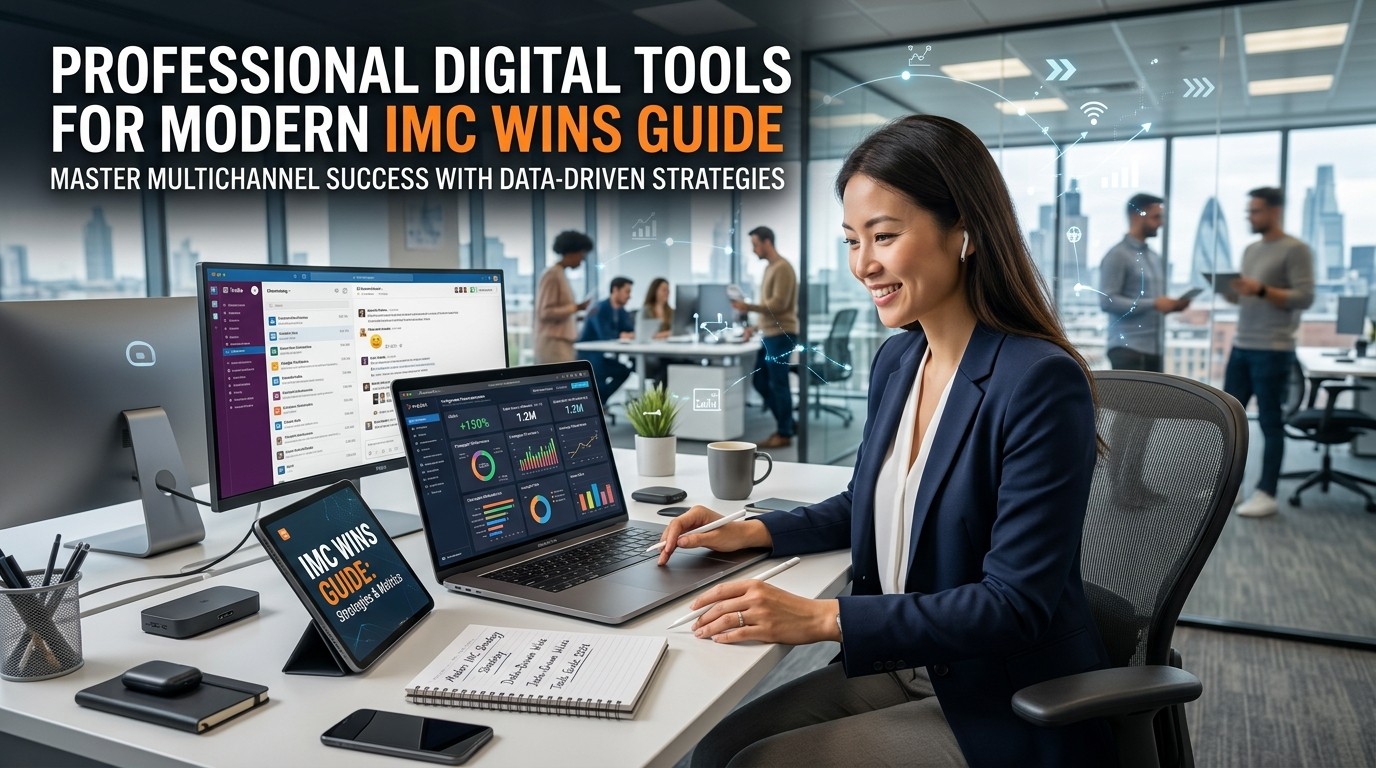
Digital Tools for Modern IMC help brands coordinate messaging, measure results, automate follow-up, and keep teams aligned so every channel supports one clear customer journey.
Digital Tools for Modern IMC are no longer optional extras for marketing teams that want consistency across channels. AMA describes marketing communications as coordinated promotional messages and media used to communicate with a market, and IMC literature emphasizes coordination, media integration, and the removal of communication barriers. That is exactly the environment where Digital Tools for Modern IMC create value: they connect planning, publishing, automation, analytics, and governance so the message stays unified from first impression to final conversion.
Digital Tools for Modern IMC matter because modern customers do not move in a straight line. They may see a social post, click an email, read a landing page, compare a product page, and later return from search or app traffic. Google Analytics now focuses on website and app data together, event-based measurement, and AI-powered insights, which makes it easier to understand those journeys instead of guessing at them. When the tools are connected well, Digital Tools for Modern IMC turn scattered touchpoints into one measurable system.
Why IMC needs a digital tool stack
Digital Tools for Modern IMC work best when the team understands that integrated marketing is not only about message consistency. It is also about workflow consistency. The SAGE literature notes that IMC has become influential in company communication strategies and has contributed to brand appeal, brand equity, and brand performance. That means the tools behind the strategy need to support planning, execution, and measurement in a way that reinforces the same story everywhere. Digital Tools for Modern IMC help marketing teams do that without making every campaign feel manually stitched together.
The human psychology behind this is simple. People trust brands more when the experience feels coherent. If the ad, landing page, email, and follow-up all sound different, the buyer has to do extra mental work. Digital Tools for Modern IMC reduce that friction. They let teams keep the promise consistent while still adapting the format for each channel. That balance is where real IMC wins usually happen.
The core tool categories every team should know
Digital Tools for Modern IMC usually fall into a few practical groups: analytics, automation, content production, identity and access, reporting, and campaign orchestration. Google Analytics helps teams understand website and app performance, HubSpot offers automation, dashboards, lead scoring, and journey orchestration, and Microsoft Entra provides identity and access management with policy enforcement. When those layers work together, the marketing operation becomes easier to manage and less vulnerable to random breakdowns. Digital Tools for Modern IMC are strongest when they support both speed and control.
| Tool category | Primary job | Why IMC teams care |
|---|---|---|
| Analytics | Measure behavior across channels | Shows what message and channel combination works |
| Automation | Trigger follow-up and workflows | Saves time and improves consistency |
| Access control | Protect accounts, apps, and data | Reduces security and governance risk |
| Reporting | Share performance clearly | Helps teams make faster decisions |
| Creative tooling | Build content and assets | Keeps brand output fast and consistent |
This kind of stack is especially useful because IMC is not a single-channel discipline. The point is to coordinate channels, not treat them as separate kingdoms. Digital Tools for Modern IMC let the organization see the full picture instead of forcing each team to guess what the others are doing.
Analytics as the decision engine
Digital Tools for Modern IMC should start with measurement because you cannot coordinate what you cannot see. Google Analytics says it helps users fine-tune digital strategy, optimize campaigns, and understand website and app performance. GA4 also supports cross-app and website measurement in one place, with event-based data, privacy controls, predictive capabilities, and direct integrations to media platforms. That makes analytics the central nervous system of a modern IMC program.
Digital Tools for Modern IMC become much easier to justify when analytics shows how people actually move. A customer may click an ad on one device, browse on another, and convert later. Without unified analytics, those steps can look disconnected. With GA4-style measurement, the team can see engagement across app and website in one place, which makes it much easier to judge whether the IMC plan is truly working or just sounding good in meetings.
Automation that keeps the brand rhythm steady
Digital Tools for Modern IMC should not rely on people remembering every follow-up task. HubSpot says marketing automation software can run campaigns on autopilot with CRM-powered workflows, email automation, scoring, and journey orchestration. It also says automation can personalize messages, route leads, and re-engage contacts based on behavior. That is exactly what IMC teams need when they want the same brand voice to continue across email, web, and sales touchpoints.
The best automation is invisible to the customer but obvious to the team. Digital Tools for Modern IMC make that possible by saving time on repetitive work and letting marketers focus on strategy, not manual sending. HubSpot’s product pages also highlight custom workflows, segmentation, predictive lead scoring, and campaign dashboards, which are useful because they show how automation and reporting can live in the same environment. Digital Tools for Modern IMC work best when automation is connected to real customer context instead of generic scheduling.
Reporting that people actually read
Digital Tools for Modern IMC need reporting that helps people act, not just admire charts. HubSpot says its dashboards let teams see campaign performance data in one place and share reports with stakeholders, and it also references multi-touch revenue attribution and customer journey analytics. That matters because IMC is about orchestrated communication, so the reporting has to reflect orchestration rather than isolated channel wins.
Digital Tools for Modern IMC should make it easy to answer questions like: Which channel started the journey? Which message moved the buyer forward? Which audience segment responded best? Once those questions are visible, the team can adjust creative, budget, and timing with much more confidence. Reporting is not only for executives. It also gives marketers the feedback they need to improve the next campaign instead of repeating the last one.
Identity, access, and governance are part of marketing too
Digital Tools for Modern IMC are often discussed as a creative or analytics issue, but identity and access matter just as much. Microsoft Entra ID is a cloud-based identity and access management service that provides authentication, policy enforcement, and protection for users, devices, apps, and resources. Microsoft Entra Conditional Access is its Zero Trust policy engine, using identity-driven signals to enforce organizational policies. For teams with many marketing tools, this is critical because campaign data, customer data, and publishing permissions all need to be controlled.
Access Management Tools help prevent account misuse, accidental edits, and the sort of permission sprawl that often grows in busy marketing departments. Digital Tools for Modern IMC become more trustworthy when the people using them have the right access level and nothing more. This is especially important when teams collaborate across agencies, regions, and departments. A strong IMC system is not only coordinated in messaging; it is coordinated in security and governance as well.
Content production tools that keep the message moving
Digital Tools for Modern IMC also need to support the actual production of content. HubSpot’s marketing product pages include SEO recommendations, email tools, AI content generation, chatbots, forms, and dynamic content, which shows how a modern marketing platform can cover multiple stages of the communication journey. That matters because IMC loses force when the content team is waiting on ten different tools to produce one campaign.
When teams use Free AI Tools for Digital Marketing carefully, the goal is not to replace strategy. The goal is to reduce repetitive production work so the team can spend more time on message quality, audience fit, and testing. Digital Tools for Modern IMC benefit from AI when the output still reflects brand standards and human judgment. AI is useful when it speeds up drafts, variants, and support content; it is risky when it replaces the thinking process behind the campaign.
How small teams can still build an IMC system
Digital Tools for Modern IMC are not only for enterprise companies with huge budgets. Smaller organizations can use the same logic with fewer tools and simpler workflows. HubSpot’s marketing suite shows how dashboards, email tools, lead management, forms, and automation can live in one platform, which is useful for teams that need simplicity more than customization. That is why Small Business Digital Marketing Tools should be chosen for clarity, not just for price.
For a small team, the right stack often means fewer platforms and cleaner processes. One analytics tool, one automation tool, one access system, and one reporting dashboard may be enough to create a meaningful IMC workflow. Digital Tools for Modern IMC do not have to be complicated to be effective. They just need to make sure the same message reaches the right person at the right time through the right channel.
A practical way to compare the market

Digital Tools for Modern IMC should be selected by function, not hype. A Security Software Market Map is useful as a planning lens because it helps teams separate access management, compliance, analytics, automation, and creative software into distinct layers. That prevents the common mistake of buying a tool for one feature and expecting it to solve the whole marketing problem. The right map helps the team ask whether it needs measurement, orchestration, security, or content support first. Digital Tools for Modern IMC become easier to buy when the stack is viewed as a system instead of a shopping list.
That same view also reduces confusion during procurement. If a team knows which tools are responsible for access, reporting, workflow, and content, it can choose better vendors and avoid overlap. Digital Tools for Modern IMC should be selected to fill gaps in the workflow, not duplicate what another platform already does. That discipline saves money and makes adoption easier.
A simple workflow for modern IMC
Digital Tools for Modern IMC work best when the workflow is straightforward. Start with audience understanding, build a consistent message, distribute it through coordinated channels, automate the follow-up, measure the response, and refine the next cycle. That basic structure reflects the IMC literature’s focus on coordination, integration, and reduced communication barriers. The exact tools can change, but the flow should stay stable.
A practical workflow might look like this: plan the message in the campaign tool, publish or schedule content through the automation layer, monitor behavior in analytics, secure the environment with identity controls, and compile results in the reporting dashboard. Digital Tools for Modern IMC are most useful when each step hands off cleanly to the next one. That is how teams stop working in fragments and start working as one communication system.
The role of consistency and trust
Digital Tools for Modern IMC are not just about convenience. They shape trust. When the customer sees a clear, consistent brand experience, they feel less uncertainty. IMC theory has long emphasized coordinated messaging and media integration, and modern tools simply make that easier to execute. The stronger the coordination, the less cognitive effort the buyer needs to spend trying to interpret the brand.
That consistency also supports internal trust. When dashboards are shared, workflows are documented, and access is controlled, the team spends less time asking basic operational questions. Digital Tools for Modern IMC can therefore improve morale as well as performance, because people work better when the system around them is predictable.
Common mistakes to avoid
Digital Tools for Modern IMC often fail when teams buy too many disconnected products. Another common mistake is focusing on design and ignoring measurement. A third mistake is letting too many people publish without clear identity and access rules. Microsoft Entra and conditional access guidance make it clear that access should be policy-driven, while Google Analytics shows why measurement should be central from the beginning. The strongest IMC programs avoid those mistakes by making tools serve the workflow instead of the other way around.
Another issue is using automation without strategy. HubSpot’s automation features are powerful, but they work best when there is a clear audience segment, a clear trigger, and a clear outcome. Digital Tools for Modern IMC are much more effective when the team uses them deliberately rather than assuming software alone will create coordination.
What to track each month
Digital Tools for Modern IMC should be judged by a few useful metrics: campaign performance, engagement across channels, lead movement, conversion behavior, and report visibility. Google Analytics can help with cross-platform measurement, while HubSpot dashboards can help with customer journey analytics and revenue attribution. That combination gives a much clearer picture of whether the IMC program is actually working.
When teams review these numbers monthly, they can see whether the message is consistent, whether automation is helping, and whether any access or workflow issue is slowing the process. Digital Tools for Modern IMC create value when they reveal where to improve next. A dashboard is not useful because it exists. It is useful because it helps the team make a better decision.
Choosing tools that fit your stage

Digital Tools for Modern IMC should match company maturity. Early-stage teams usually need clarity, speed, and basic measurement. Growing teams need automation, segmentation, and reporting. Larger teams need governance, access control, and cross-channel analytics. HubSpot, Google Analytics, and Microsoft Entra show how different layers of the stack support different needs, and that is why the best stack is rarely the largest one. It is the one that fits the current stage of the business.
That is also why the phrase Digital Tools for Modern IMC is more than a category label. It is a decision framework. Once a team knows its stage, it can decide whether it needs better measurement, better automation, better creative production, or better access control. The answer is usually a combination, but the priority order matters.
Conclusion
Digital Tools for Modern IMC help brands turn integrated marketing from a theory into a working system. They connect planning, content, analytics, automation, reporting, and access control so the message stays consistent and the workflow stays measurable. The best tools do not just make marketing faster. They make it clearer. When a team can see the whole journey, automate the routine parts, protect the environment, and measure what happens next, it becomes much easier to make smart decisions. That is the real advantage of Digital Tools for Modern IMC: they reduce friction for the team and confusion for the customer at the same time.
Frequently Asked Questions (FAQ)s
1. What does Digital Tools for Modern IMC mean?
It refers to the software stack that helps marketing teams coordinate messaging, automate workflows, measure performance, and manage access across channels.
2. Why is IMC important today?
IMC matters because coordinated marketing messages and media help brands stay consistent, and modern research links IMC to stronger brand appeal, equity, and performance.
3. Which analytics tool is most useful for IMC?
Google Analytics is especially useful because it helps measure both website and app performance, and GA4 brings engagement data together in one place.
4. How does automation help IMC?
Automation helps by sending the right follow-up at the right time, reducing repetitive work, and keeping the campaign journey consistent across channels.
5. Why do access controls matter in marketing?
Access controls matter because marketing systems contain customer data, campaign assets, and publishing permissions, so identity and policy enforcement help prevent mistakes and misuse.
6. Can small teams use Digital Tools for Modern IMC effectively?
Yes. Small teams can use fewer tools with clearer workflows and still create strong coordination, especially when the stack includes analytics, automation, and reporting.
7. What is the best way to choose tools?
Choose by workflow gap, not by hype. The right tool should solve a specific problem such as measurement, automation, access, or reporting.
8. How do Free AI Tools for Digital Marketing fit in?
They can speed up drafts, variants, and support content, but they work best when human strategy and brand control still guide the final output.
9. What is the role of a Security Software Market Map?
It helps teams compare security, identity, and governance tools so they can place marketing software in the right part of the stack.
10. What should a modern IMC dashboard show?
It should show campaign performance, engagement, lead movement, and customer journey signals so the team can make better decisions quickly.


Leave a Reply